
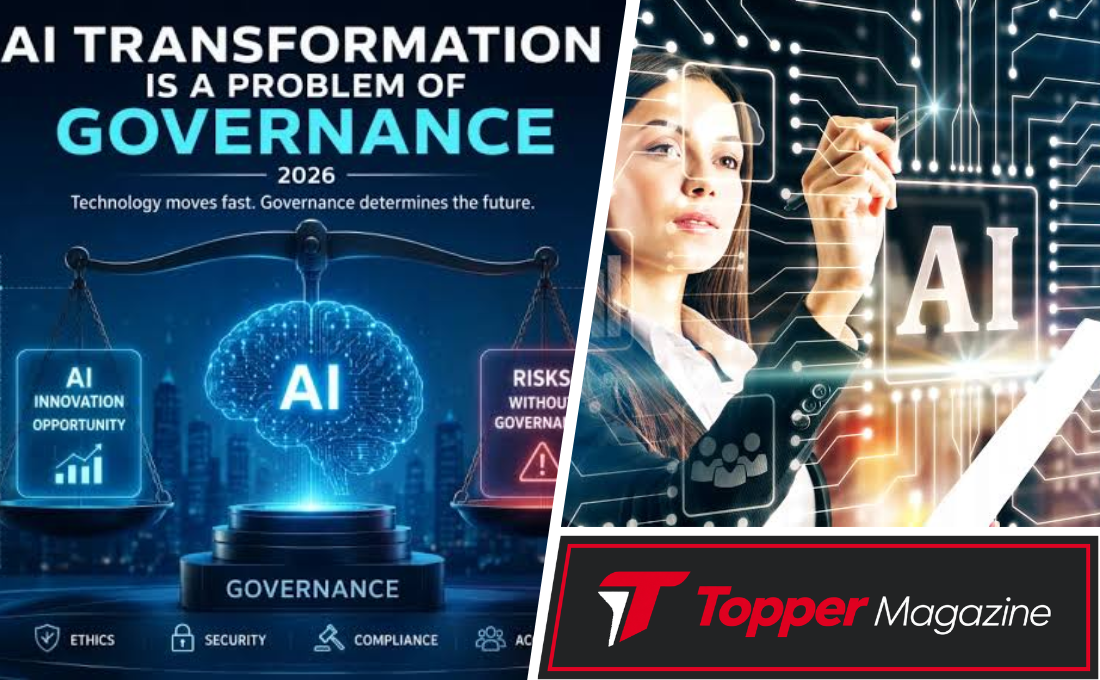
AI transformation is a problem of governance Twitter has become a curious search phrase as conversations about artificial intelligence move beyond clever chatbots and impressive demos. The main idea is surprisingly simple: the hardest part of bringing AI into a company may not be building the technology at all. It may be deciding who controls it, what it is allowed to do, who checks its work, and who takes responsibility when something goes wrong. That idea also matches the approach behind the NIST AI Risk Management Framework, which treats governance as a central part of managing AI risk.
The phrase has appeared in articles and wider conversations connected with Twitter, now called X. But it should not be understood as one mysterious tweet that suddenly changed the AI industry. It is better understood as a short way of describing a much bigger problem that businesses, governments, developers, and ordinary AI users are beginning to face.
What Does “AI Transformation Is a Problem of Governance” Actually Mean?
Imagine a company gives every employee a powerful new AI assistant.
At first, everyone is excited.
The marketing team uses it to write ideas. Customer support uses it to answer questions. Managers use it to summarize documents. Developers use it to create code.
Everything looks easy.
Then someone asks a simple question:
What information is the AI allowed to see?
Suddenly, things become complicated.
Can an employee paste customer information into it? Can the AI read private company documents? Can it automatically send an email? Can it reject a job applicant? Can it make a financial recommendation?
And if the AI gives the wrong answer, who is responsible?
That is where governance begins.
AI governance is basically the set of rules, responsibilities, checks, and decision-making systems that control how artificial intelligence is used.
Technology tells us what AI can do.
Governance tells us what AI should be allowed to do.
That difference is at the heart of the entire debate.
Why Is Twitter Mentioned in This Search?
The keyword looks unusual because it combines two ideas: AI governance and Twitter.
Twitter officially became X, but millions of people still use the older name when searching online.
Technology leaders, developers, researchers, business owners, and policymakers regularly discuss AI on X. Short statements can quickly turn complicated technology issues into memorable ideas.
“AI transformation is a problem of governance” is exactly that kind of statement.
It makes people stop and think.
For years, companies often talked about AI transformation as if it were mainly a shopping problem.
Which AI model should we buy?
Which chatbot is best?
Which company has the fastest model?
How much computing power do we need?
Those questions still matter, but they are only the beginning.
Once AI starts entering real business processes, the bigger questions become about authority and responsibility.
That is why the governance argument has gained attention far beyond social media. Zapier published an article in May 2026 arguing that unclear AI governance can stop transformation from scaling safely, while other organizations have made similar arguments about ownership, risk management, and decision-making.
AI Adoption and AI Transformation Are Not the Same Thing
This difference is important.
Using ChatGPT to improve an email is AI adoption.
Giving an entire company access to AI tools is broader adoption.
Changing the way the whole company works because AI can now perform parts of research, customer service, coding, analysis, sales, or administration is transformation.
Transformation goes much deeper.
It changes jobs.
It changes workflows.
It changes who makes decisions.
It can even change which employees or departments have power inside an organization.
That is why transformation needs stronger rules than simply trying a new tool.
A small experiment can be stopped in seconds.
A deeply connected AI system may be linked with customer databases, internal documents, email systems, financial software, and dozens of other business tools.
The more access AI receives, the bigger the governance question becomes.
The Real Problem Starts With “Who Is Responsible?”
Suppose an employee makes a mistake.
A manager usually knows who performed the work.
Now suppose an AI system makes the mistake.
Things become less clear.
Was the employee responsible because they used AI?
Was the manager responsible because they approved the system?
Was the developer responsible because they created it?
Was the AI company responsible because its model generated the answer?
Was the business responsible because it allowed AI to make the decision?
This is one reason AI governance matters so much.
Responsibility cannot simply disappear because software was involved.
The OECD’s AI Principles emphasize accountability, transparency, human oversight, security, and continuing risk management across the AI lifecycle. These ideas show that governance is not just about government regulation. It also happens inside companies whenever people decide how an AI system may operate.
A Simple Example Makes the Problem Clear
Imagine two companies using the same AI model.
Company A allows employees to use it however they want.
There are no clear rules.
Nobody knows whether confidential information can be entered.
Nobody checks AI-generated work.
There is no record of which tasks are being automated.
Company B uses exactly the same AI model.
But before using it, the company decides which information the AI can access, which tasks require human approval, who owns each system, how mistakes are reported, and when the AI must be switched off.
Which company is safer?
Probably Company B.
Yet the AI technology itself is identical.
The difference is governance.
This is why saying “we use the best AI model” does not automatically mean an organization has a strong AI strategy.
The model can be excellent while the system around it is terrible.
Why Buying Better AI Does Not Solve Everything
There is a natural temptation to think every AI problem can be fixed with a smarter model.
Sometimes it can.
Better models may hallucinate less, follow instructions more accurately, understand more complicated information, or complete tasks faster.
But intelligence does not automatically create control.
Imagine a very smart employee with access to every file, every customer account, every email, and the ability to spend company money without approval.
Being smart would not remove the need for rules.
It would make those rules even more important.
AI works in a similar way.
As AI systems become more capable, organizations may give them more access and responsibility.
That increases the need for governance rather than reducing it.
AI Agents Make Governance Even More Important
The debate becomes even more interesting when we look at AI agents.
Traditional chatbots usually wait for a user.
You ask something.
The chatbot answers.
AI agents can potentially go further.
They may be able to search information, communicate with software, create files, update databases, trigger workflows, or carry out several steps toward a goal.
This means the question changes from:
“What can the AI say?”
to:
“What can the AI do?”
That is a much bigger question.
An incorrect paragraph from a chatbot might be annoying.
An automated system taking the wrong business action could be expensive.
For this reason, permissions become extremely important.
Organizations have to decide which actions require human approval and which can happen automatically.
Data Governance Is Part of AI Governance
AI needs information.
That sounds obvious, but it creates one of the biggest challenges.
Companies often have huge amounts of data spread across emails, cloud storage, customer systems, spreadsheets, databases, and internal tools.
Not every employee is allowed to see everything.
AI should not magically receive more permission than the person using it.
Consider a company with salary records, legal documents, customer details, future product plans, and confidential contracts.
Connecting AI to all of that data without careful controls could create serious problems.
This is why AI transformation often exposes older problems that companies already had.
Poorly organized data becomes an AI problem.
Weak access controls become an AI problem.
Unclear ownership becomes an AI problem.
Bad cybersecurity practices become an AI problem.
AI did not necessarily create those weaknesses.
It simply made them harder to ignore.
Human Oversight Still Matters
A common mistake is believing that using AI removes humans from responsibility.
In many important situations, the opposite is more sensible.
Humans need to know when an AI system is being used, what it is trying to accomplish, and when someone should step in.
The NIST AI Risk Management Framework organizes AI risk work around four broad functions: Govern, Map, Measure, and Manage. Governance is designed to run across the other functions rather than being treated as something companies think about only after deployment.
That idea is useful because AI risks can change.
A system that seems harmless today might become more powerful after an update.
A company might connect it to new information.
Employees might begin using it for tasks nobody originally expected.
Governance therefore cannot be a document that is written once and forgotten.
It has to continue as the technology changes.
Does Governance Slow AI Innovation?
This is one of the most interesting parts of the debate.
Some people worry that too many rules will make companies afraid to experiment.
That concern is understandable.
If every tiny AI experiment requires months of meetings, paperwork, and approval, employees may stop trying new ideas.
But weak governance creates the opposite problem.
A company can move very quickly at first and then suddenly hit a wall because security teams, legal teams, customers, or executives discover risks that were never considered.
Good governance should therefore work more like road markings than a brick wall.
Road markings do not stop a car from moving.
They help everyone understand where movement is safe.
The same principle can work with AI.
Low-risk tasks can often have simple rules.
Higher-risk uses need stronger controls.
The level of oversight should fit the possible harm.
Why Leadership Cannot Leave AI Only to the IT Department
AI transformation affects far more than technology teams.
It can influence hiring.
It can affect customer communication.
It can change financial decisions.
It can alter marketing.
It can touch privacy, cybersecurity, intellectual property, contracts, operations, and company culture.
That means an IT department cannot answer every important AI question alone.
Technology teams may understand how a system works.
Legal teams may understand regulatory risk.
Security teams may understand data protection.
Managers understand business processes.
Employees understand how the work is actually performed.
Leadership has to connect these different views.
That is governance.
NIST’s framework specifically recognizes organizational management, senior leadership, and boards among the actors involved in AI governance.
What Good AI Governance Looks Like in Everyday Language
AI governance can sound like something only huge corporations need.
It does not have to be complicated.
At its core, a company needs clear answers to a small group of questions:
Who owns this AI system? What is it being used for? What information can it access? What could go wrong? Who checks important outputs? How are problems reported? When should the system be stopped?
Those questions sound simple.
Answering them consistently across a large organization can be difficult.
Different teams may use different AI products.
Some employees may sign up for tools without telling the company.
Departments may create their own automated workflows.
One system can quietly become twenty systems.
This is sometimes called AI sprawl.
Governance creates visibility.
A company cannot manage AI safely if it does not even know where AI is being used.
Why Smaller Businesses Should Care Too
It is easy to think governance is only for banks, governments, hospitals, and giant technology companies.
Small businesses also face many of the same basic questions.
A small online store might use AI to answer customers.
A marketing agency might use it to write client content.
A recruitment company might use it to analyze applications.
A blogger might use AI to create articles.
The risks are different in size, but the basic idea remains.
Someone needs to understand how AI is being used.
For a small team, governance might simply mean having clear internal rules rather than creating a large committee.
The goal is not bureaucracy.
The goal is control.
Twitter and X Also Show the Other Side of AI Governance
There is another reason the Twitter connection is interesting.
Social platforms themselves face AI-related governance questions.
Generative AI can make text, images, audio, and video easier to produce at enormous scale.
That creates difficult questions about misinformation, impersonation, synthetic media, moderation, automated accounts, and transparency.
Who decides what should be labelled?
What should happen when realistic AI-generated content misleads people?
How should platforms balance safety with freedom of expression?
These are not simply engineering problems.
They involve policies, values, rights, and responsibility.
Once again, the conversation returns to governance.
The OECD’s updated AI principles specifically discuss risks such as misinformation and disinformation while also stressing the importance of respecting freedom of expression.
Is AI Transformation Really Only a Governance Problem?
Not completely.
This is an important distinction.
Calling AI transformation a governance problem is useful because it reminds companies that technology alone is not enough.
But AI transformation can also fail because of poor data, weak strategy, bad training, unrealistic expectations, unsuitable technology, employee resistance, or processes that should never have been automated.
Governance is therefore a major piece of the puzzle, not the entire puzzle.
A September 2026 analysis from Scaled Agile makes a similar point: governance gaps matter, but deeper organizational problems such as disconnected teams and weak alignment between strategy and execution can also prevent AI from scaling successfully.
That makes the Twitter phrase more useful when treated as a warning rather than an absolute law.
Why This Debate Will Probably Become Bigger
AI systems are moving quickly from tools that generate information toward systems that can participate in real workflows.
That raises the stakes.
When AI is only helping someone rewrite a sentence, governance may feel distant.
When AI is making recommendations about money, employment, healthcare, security, customers, or business operations, governance suddenly becomes impossible to ignore.
Governments are developing rules.
Standards organizations are creating frameworks.
Companies are creating internal AI policies.
Employees are asking what tools they may use.
Customers increasingly want to know how their information is handled.
All of these changes point toward the same conclusion.
The future of AI will not be decided only by who builds the smartest model.
It will also be shaped by who creates the clearest, fairest, and most practical rules for using those models.
Final Thoughts
The phrase “AI transformation is a problem of governance Twitter” may look like an awkward internet search, but the idea behind it is powerful.
AI transformation is not simply about adding a chatbot to a website or giving employees a new software tool.
Real transformation changes how decisions are made.
It changes who has access to information.
It changes how work moves through an organization.
And sometimes it gives software the ability to influence actions that were once controlled completely by humans.
That is why governance matters.
The winning organizations may not simply be the ones that adopt AI fastest.
They may be the ones that understand exactly where AI should be used, where humans should remain involved, who owns the risks, and what should happen when the technology fails.
AI gives organizations new power.
Governance decides how wisely that power is used.
FAQs
What does “AI transformation is a problem of governance” mean?
It means the biggest difficulties with large-scale AI adoption are often related to rules, responsibility, data access, risk, and decision-making rather than simply the quality of the AI technology.
Why does the keyword include Twitter?
The phrase is associated with wider AI discussions online, including Twitter, now called X. Technology leaders, researchers, businesses, and policymakers frequently use social platforms to debate questions about AI responsibility and regulation.
Is Twitter now called X?
Yes. Twitter was renamed X, although many people still search for and refer to the platform using the older Twitter name.
What is AI governance?
AI governance is the collection of rules, responsibilities, processes, and controls used to guide how AI systems are developed and used.
Why is AI governance important for businesses?
It helps businesses decide who can use AI, what information AI can access, which decisions require human review, how risks are monitored, and who is responsible when problems occur.
Can AI governance stop innovation?
Poorly designed governance can create unnecessary delays, but practical governance can make innovation easier by giving employees clear boundaries for safe experimentation.
Do small companies need AI governance?
Yes, although it does not need to be complicated. Even a small company should understand which AI tools are being used, what data employees put into them, and who checks important AI-generated work.
Will AI governance become more important in the future?
Most likely. As AI systems gain more capabilities and become connected to important business processes, questions involving permissions, accountability, security, transparency, and human oversight become more important.
For more detailed celebrity-family biographies, hidden life stories, and interesting profiles behind famous names, visit Topper Magazine.
