

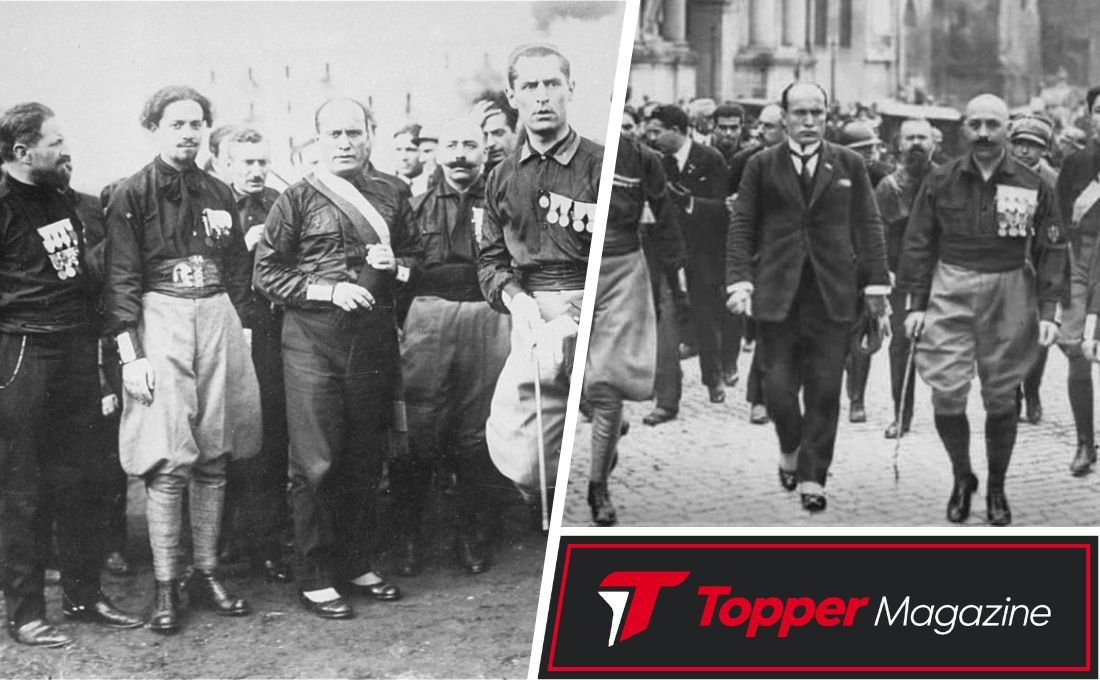
Fascisterne is a Danish word meaning “the fascists,” referring to people who support fascism. You might find it in a history book, a Danish newspaper or a discussion about European politics. Although the spelling may look unfamiliar to English readers, its meaning becomes clearer once you separate the language from the history.
There are two useful questions to ask. What does the word mean in a sentence? And what ideas or people does it describe?
The first question has a fairly simple answer. The second takes us into a difficult period of history, when political movements promised national greatness while attacking democracy and personal freedom.
What Does Fascisterne Mean?
In Danish, fascisterne means “the fascists.” It is the definite plural form of fascist, a word for a supporter of fascism.
The related forms help explain the spelling:
| Danish word | English meaning |
|---|---|
| Fascist | Fascist |
| Fascisten | The fascist |
| Fascister | Fascists |
| Fascisterne | The fascists |
| Fascisme | Fascism |
| Fascistisk | Fascist or fascistic, used as an adjective |
The ending changes how the noun works in a sentence. In this case, Danish places the definite ending on the noun, where English uses the separate word “the.” The forms and basic definition are recorded in Den Danske Ordbog.
Here is a simple example written for explanation:
“Bogen handler om fascisterne i Italien.”
This means: “The book is about the fascists in Italy.”
The word itself does not identify one particular party. The surrounding sentence tells you which people, movement or historical period the writer means.
Why the Context Matters
Imagine finding fascisterne beneath an old photograph. Without reading the caption, you might know that the writer is referring to fascists, but you would not yet know their country or organization.
The same care applies to a political argument. Someone may use the word as a historical description, while another person may use it as an accusation.
A good reader pauses and asks: Who is being described? What actions are being discussed? What evidence supports the label?
Those questions keep a serious historical term from becoming just another angry word.
What Was Fascism?
Fascism is a far-right political ideology associated with extreme nationalism, authoritarian leadership and opposition to democracy. It places a particular vision of the nation above individual rights.
Under fascist thinking, the leader claims to speak for the nation as a whole. People who challenge that leader can then be presented as enemies of national unity.
Historical fascist movements also accepted political violence as a way to gain or defend power. Their methods included intimidation, organized attacks and the suppression of opponents. US Holocaust Memorial Museum’s explanation of fascism
For a simple way to understand the problem, think about the difference between belonging and obedience. People can care deeply about their community while still questioning its leaders. A political system becomes dangerous when it treats those questions as betrayal.
Where Did the Name Come From?
The history of the word reaches back to an ancient Roman symbol: a bundle of rods associated with an axe, known as the fasces. It represented public authority.
Much later, Italian Fascists adopted this older symbol for their modern political movement. The Danish word fascisme belongs to the same family of terms. Danish dictionary entry on fascisme
However, the ancient object and the twentieth-century ideology are not the same thing. A symbol can exist for centuries before a later movement gives it a new political meaning.
That distinction is useful when looking at old buildings, paintings or monuments. To understand a symbol, you need to know when it was used and why.
How Fascism Developed in Italy
Italy was central to the rise of organized fascism. In March 1919, Benito Mussolini founded a movement in Milan that brought together supporters, including war veterans.
The movement combined nationalism, hostility to socialism and opposition to democratic politics. Violence was an important part of its attempt to gain influence. Lex’s history of fascism
The years after the First World War created opportunities for such movements. Economic problems, political conflict and public frustration weakened trust in existing leaders.
Mussolini offered a story of national strength and renewal. For some supporters, that promise mattered more than the danger posed by his methods.
Understanding why people joined does not excuse what followed. It helps explain how a movement that attacked freedom could still attract support.
Mussolini and the March on Rome
In October 1922, Fascist forces mobilized in the event known as the March on Rome. Their pressure helped bring Mussolini to power when King Victor Emmanuel III invited him to form a government.
An important detail is that Mussolini did not personally lead the initial armed advance into the capital. He remained in Milan while events unfolded.
His appointment as prime minister also did not immediately give him unlimited authority. He consolidated power over the following years, establishing a dictatorship in 1925. US Holocaust Memorial Museum’s biography of Mussolini
This history shows why a single dramatic event rarely explains an entire political transformation. Changes to laws, institutions and the treatment of opponents also matter.
A country may keep familiar government buildings and official titles even while the freedom to challenge its rulers disappears.
What Did Fascist Rule Look Like?
Fascist rule involved more than a powerful leader giving speeches. It sought to organize society around the ruling movement and its vision of the nation.
Loyalty to the Leader
The leader was presented as an exceptional figure whose judgment deserved public devotion. This encouraged people to connect loyalty to their country with loyalty to one person.
Public Displays of Support
Large rallies and organized events made political belonging visible. Fascist movements wanted active public participation through channels controlled by the movement.
Propaganda
Images, speeches and repeated messages helped build the leader’s public image. In Mussolini’s Italy, even classroom portraits and themed calendars contributed to that image. Council on Foreign Relations’ guide to fascism
These methods invite a useful question: are people free to disagree, or are they expected to perform agreement?
A cheering crowd alone cannot answer that. The treatment of critics tells us much more.
Were Fascism and Nazism the Same?
The terms are related, but they should not be treated as exact replacements for each other.
Fascism describes a broader political category. Nazism refers specifically to the ideology and movement associated with Adolf Hitler and the Nazi Party.
The Nazi regime combined dictatorship and extreme nationalism with a central commitment to antisemitism and a false racial hierarchy. Its persecution developed into systematic mass murder, including the Holocaust. The US Holocaust Memorial Museum identifies Nazi Germany as a fascist government. Fascism and Nazi Germany
Being precise helps us understand both the shared features and the differences. It also prevents the history of particular victims and policies from disappearing inside a general label.
What Happened to Mussolini’s Regime?
Military defeats weakened Mussolini’s position during the Second World War. In 1943, the king removed him from power, and he was arrested.
German forces later helped restore him as the head of a dependent regime in northern Italy. As the war approached its end, Italian partisans captured and executed him in April 1945. Mussolini’s wartime downfall
The photographs of resistance fighters at the beginning of this article show another part of the story: people who fought against Fascist rule and German occupation.
History should include those who resisted as well as those who governed. Otherwise, the most powerful figures can crowd everyone else out of the picture.
Does Fascisterne Mean “Strict People”?
No. A strict teacher, demanding manager or unpopular official is not automatically a fascist.
The Danish dictionary does record a broader, figurative use connected with strongly right-wing nationalist views or authoritarian suppression of people who think differently. That still carries a much more serious meaning than simply enforcing rules. Den Danske Ordbog’s definitions
For clear writing, describe the behavior first. Did someone refuse discussion? Threaten a critic? Support political violence? Try to remove democratic checks?
Specific descriptions are more useful than a label left unexplained.
How to Read the Word in an Article
When you encounter fascisterne, start with the sentence around it. A translation gives you the basic meaning, but the wider passage gives you the subject.
Next, check the place and date. A paragraph about Italy in 1922 will have a different context from a modern opinion column.
Finally, separate the writer’s evidence from the writer’s judgment. Historical documents, named organizations and recorded actions provide something you can examine. An accusation without explanation gives you much less.
For content writers, this is also a valuable habit. Explain unfamiliar words early, give concrete examples and avoid making readers guess what a strong political term is supposed to mean.
Final Thoughts
Fascisterne means “the fascists” in Danish. Understanding that translation is the first step; understanding the history gives the word its weight.
The subject involves dictatorship, political violence, the loss of rights and the people who resisted those forces. Clear language helps readers approach that history without turning it into either a confusing lecture or a careless insult.
FAQs
What does fascisterne mean in English?
It means “the fascists.” It is the Danish definite plural form of fascist.
Is fascisterne the name of a political party?
Not by itself. It describes a group of fascists, and the surrounding text identifies which group is meant.
What is the difference between fascisterne and fascisme?
Fascisterne refers to people: “the fascists.” Fascisme refers to the ideology: “fascism.”
Why is Mussolini connected with this word?
Mussolini founded the Italian Fascist movement and later ruled Italy as a dictator. Discussions of historical fascism therefore often include him.
Are fascism and Nazism identical?
No. Nazism is commonly understood as a form of fascism, but it has a specific history and ideology, including its central antisemitism and racial doctrines.
Does being patriotic make someone a fascist?
No. Caring about a country does not itself imply support for dictatorship, political violence or the suppression of other people’s rights.
How can I use fascisterne correctly?
Use it when writing Danish and referring to “the fascists.” Make the context clear so readers know which people or historical movement you mean.
For more detailed celebrity-family biographies, hidden life stories, and interesting profiles behind famous names, visit Topper Magazine.
