

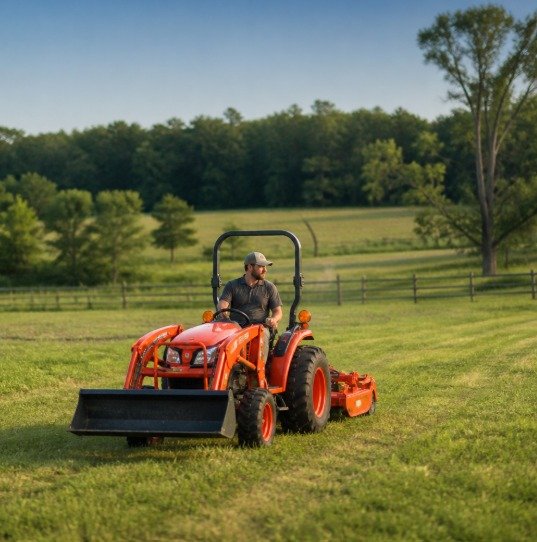
Most people who buy their first compact tractor make one of two mistakes. They buy too small, discover the loader cannot lift a round bale or a pallet of fence posts, and trade out within two seasons. Or they buy too big, then spend the next decade dragging a machine that weighs more than their driveway can take through gateways it barely fits. Getting the size right the first time is less about horsepower bragging rights and more about matching three things: the heaviest job you actually do, the implements you intend to run, and the ground you have to drive on.
Start With the Jobs, Not the Spec Sheet
Write down every task you expect the tractor to handle over a full year, then rank them by difficulty. Mowing ten acres of rough pasture, moving manure, pulling a 6-foot box blade, loading gravel, lifting wrapped bales and running a post driver all make very different demands. The job at the top of that list — the single hardest thing you will ask of the machine — sets your minimum. Everything below it will be comfortable.
Loader work is usually the quiet decider. People shop on engine horsepower and then discover that lift capacity at full height, not at the pins, is what determines whether a bale goes onto a trailer or stops at chest level. Ask for the figure at maximum height and at the bucket’s centre of gravity, because that is the number you will live with. Similarly, three-point hitch lift capacity matters more than PTO horsepower for anyone running heavy rear-mounted gear such as a rotary cutter, a tiller or a big back blade.
A rough guide by land size
- Under 5 acres, mostly lawn and light chores: a sub-compact or small compact in the low-to-mid 20s horsepower range, with a loader and a mid-mount or rear finish mower.
- 5 to 20 acres with pasture, trails and some loader work: a compact in the 25 to 40 horsepower band, four-wheel drive, loader, rotary cutter and a box blade.
- 20 to 60 acres with hay, livestock and bale handling: a 45 to 75 horsepower utility tractor with a serious loader, grapple-capable hydraulics and enough rear weight for ground-engaging tools.
- Above that, or if you bale and wrap in volume: a utility or mid-range tractor sized to your baler’s PTO requirement, not to your field size.
Treat those bands as starting points. Steep ground, heavy clay and long drag distances all push you up a band. Flat, light soil and short runs let you stay down one. If you want a second opinion before you shop, the hobby-farming explainer on how much horsepower a farm tractor actually needs is a sensible, jargon-light sanity check against dealer enthusiasm and your own.
Implements Set the Specification
Buy the implements on paper before you buy the tractor. Every implement has three numbers that constrain the machine: PTO horsepower required, weight, and working width. A 6-foot rotary cutter wants roughly 35 to 40 PTO horsepower to cut heavy growth without bogging; a 5-foot one will run happily behind something considerably smaller. A round baler is the least forgiving item on most farms, because it needs both the PTO power and the hitch weight to handle a loaded bale on a slope.
Hydraulics deserve attention too. If a grapple, a hydraulic top link or a front snow blade is in your future, you need the remote valves and the flow to run them. Adding a third-function valve later is possible but rarely cheaper than ordering it fitted. The same goes for transmission choice: hydrostatic drive is a pleasure for loader work and mowing around obstacles, while a geared or shuttle transmission is usually preferred for sustained draft work and tends to feel more deliberate in the field.
Why pre-built packages often win
Tractor packages — a machine, loader, trailer and one or two implements matched as a set — exist because mismatches are so common. The package approach guarantees the cutter is not too wide for the PTO, the trailer is rated for the combined weight, and the loader is the correct model for that chassis. For a first-time buyer, that removes most of the expensive guesswork. Custom packages are worth asking about where your jobs are unusual, say a narrow orchard or a property with a long, washed-out track that demands a blade and a rear grader rather than a mower.
Where a Dealer Earns Its Keep
The purchase is the short part of the relationship. What matters over ten years is whether somebody can get you a hydraulic hose, a filter kit or a baler belt quickly in the middle of hay season, and whether the workshop can take the machine when a transmission or loader valve needs attention. That is why buyers in the mid-South and lower Midwest tend to shortlist by service footprint as much as by model: a dealership such as H&R Agri Power, an authorized Kubota dealer with locations across Kentucky, Tennessee and Indiana, sells new and used tractors and implements alongside pre-built and custom tractor packages, keeps genuine parts plus general tractor, mower and baler parts on the counter, and runs repair and service departments — including lawn mower repair at Owensboro, Kentucky. The useful questions to ask any dealer are the same: what do you stock on the shelf, how fast is a special order, and who looks at my machine when it comes in?
Genuine Parts: When It Matters and When It Doesn’t
There is a reasonable middle ground here. For anything that touches fuel, oil, hydraulics or emissions — filters, seals, injectors, hydraulic components — genuine parts are worth the premium because tolerances and filtration ratings are specified for that engine and that circuit. A cheap filter with the wrong micron rating or a collapsing element can cost an injection pump. For wear items such as cutter blades, tines, teeth and belts, quality aftermarket parts are often perfectly serviceable, provided you match the specification rather than just the dimensions.
Keep a small shelf of consumables: one set of engine, fuel and hydraulic filters, a spare set of blades, a couple of common hoses, a PTO shaft shear bolt pack and a tube of the correct grease. It is the difference between a one-hour fix and a lost weekend. Growers swap plenty of hard-won advice on exactly this kind of stocking strategy in forums and practical farm equipment discussions, and the recurring theme is always the same — the part you did not have is the one that stops the job.
A Seasonal Service Rhythm That Actually Gets Done
- Spring: full oil and filter change, air filter inspection, coolant level and condition, tyre pressures, loader pin and bucket pivot grease, battery terminals cleaned, cutting edges and blades checked for cracks.
- Before hay: go over the baler and mower conditioner properly — belts, bearings, knives, twine or net path, chains and PTO guards. This is the one inspection worth booking into a workshop if you are unsure.
- Midsummer: clean the radiator screen and cooling fins, check hydraulic oil level, inspect hoses for chafing, re-grease loader and three-point points.
- Autumn: transmission and hydraulic fluid service per the interval, wheel and loader bolt torque check, fix the small leaks before they become big ones.
- Winter: fuel treated and tank full to limit condensation, battery on a maintainer, machine stored off damp ground, implements cleaned and oiled.
Log hours, not dates. A tractor that works 400 hours a year needs a different schedule from one that works 60, and the hour meter is the only honest record you have.
The One Test Before You Sign
Demo the machine on your own ground with the implement you plan to run, on the worst day you can arrange. Drive it through your tightest gateway, reverse it into the shed, lift something heavy to full height and mow the roughest corner of the field. Five minutes of that will tell you more than a day of comparing brochures — and if the machine passes, you have almost certainly sized it right.
