

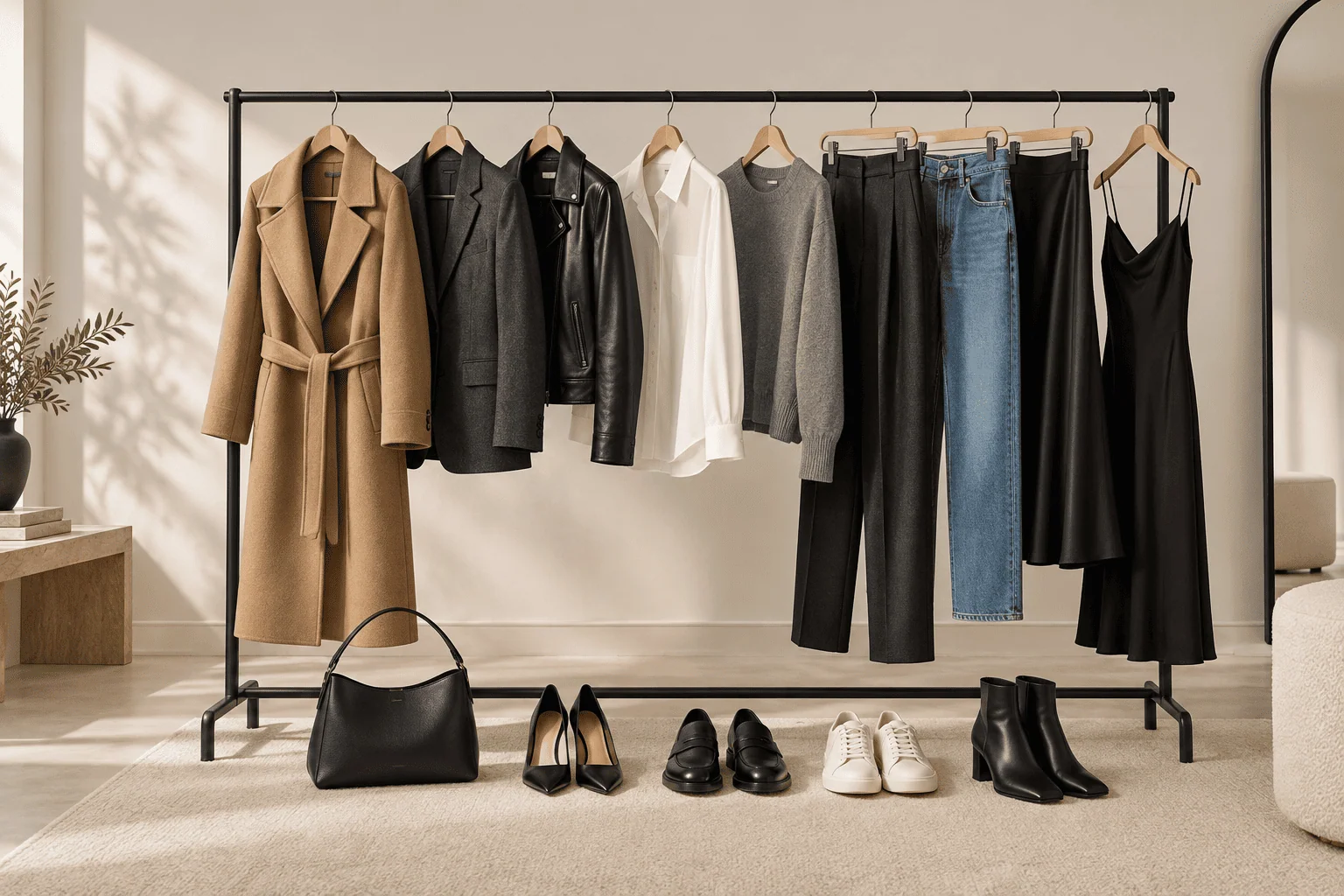
Accessorising is the practice of adding small, removable items to an outfit to change how it looks or functions. These items include jewellery, scarves, belts, bags, hats and hosiery. Unlike clothes, accessories are cheap to swap and quick to change, which makes them the most flexible tool for making one wardrobe do the work of several.
What Accessories Actually Do
Accessories carry out three jobs in an outfit.
- They set a focal point. The eye needs somewhere to land, and a bold earring, a bright scarf or a sculpted bag gives it a place to rest.
- They add contrast. A soft knit looks sharper next to a structured leather belt, and a plain dress looks richer with metallic jewellery.
- They signal the occasion. The same trousers and top read as office wear with a slim belt and stud earrings, and as evening wear with a statement necklace and a small clutch.
Understanding these jobs matters more than owning a lot of accessories. A few pieces used with intent do more than a drawer full of items chosen at random.
The One-Statement Rule
The simplest method is to give each outfit one statement and keep everything else quiet. If the earrings are bold, the necklace stays fine or is left off. If the bag is bright, the jewellery is understated. This avoids the cluttered look that appears when several strong items compete.
A useful check is to look in the mirror before leaving and remove one item. If the outfit still works, that item was not needed.
Repeat, Don’t Match
Matching every accessory exactly can look rigid. Repeating a colour or finish creates a more relaxed link instead. A tan belt echoed by tan boots, or gold earrings repeated in a watch strap or buckle, ties an outfit together without looking like a set.
Mixing metals is also fine when it is done deliberately. Pairing gold and silver works best when one metal appears in at least two places, so the combination looks planned.
Accessorising Around Jackets
A jacket is the largest item people see, which makes it a useful canvas for accessories. A few small changes can alter its character completely.
- Scarves: A scarf tucked inside a collar looks neat and formal, while one draped loosely looks relaxed. A scarf in a contrasting colour can lift a jacket in a dark shade.
- Belts: A belt worn over a longer jacket defines the waist and gives a boxy shape more structure.
- Lapel details: A brooch or pin on a lapel adds a quiet point of interest, particularly on a tailored style.
- Bag placement: A crossbody strap can crease a jacket’s shoulders, so a handheld bag or one worn on the shoulder often keeps the line cleaner.
- Sleeves and cuffs: Pushing sleeves up reveals a watch or bracelet, which adds detail without extra layers.
Jewellery should suit the neckline the jacket creates. A high collar suits earrings more than a necklace, while an open neckline leaves room for a pendant.
Accessorising Around Boots
Boots are often treated as a shoe choice rather than an accessory, but the details around them shape the outfit just as much.
- Hosiery and socks: Tights in a shade close to the boot lengthen the leg. A visible sock at the ankle adds colour and texture, and it suits chunkier styles.
- Trouser hems: Straight trousers can sit over the boot for a streamlined line, while a cropped or tucked hem shows the boot shape. The choice changes the whole silhouette.
- Hardware and trims: Buckles, studs and zips can be echoed in a belt buckle or bag fastening, which links the footwear to the rest of the outfit.
- Laces and charms: Swapping laces for a different colour or adding a small charm is an inexpensive way to refresh a pair worn often.
- Leather tone: Matching the finish of a bag, belt and boots, such as all matte or all polished, gives a more cohesive look.
One Outfit, Five Days
A single base outfit shows how much accessories can do. Take dark trousers, a plain knit, a jacket and boots, then change only the extras.
- Monday: Add a slim belt and small stud earrings for a clean, professional look.
- Tuesday: Add a printed scarf and a structured shoulder bag for colour and polish.
- Wednesday: Swap the knit for a fine top, add a pendant and let the jacket sit open.
- Thursday: Add a beanie, gloves and a crossbody bag for a casual, practical version.
- Friday: Add large earrings and a small clutch for an evening look.
Frequently Asked Questions
How many accessories should be worn at once?
There is no fixed number, but three to four visible items is a common guide. Fewer is safer, and the one-statement rule helps to keep things balanced.
Do accessories need to match each other?
No. Repeating a colour or finish looks more natural than matching exactly.
Which accessories give the most value?
A good belt, a versatile bag, a scarf and a pair of simple earrings usually cover the most outfits.
Can accessories make a jacket or boots suit more occasions?
Yes. Changing the scarf, belt, hosiery or jewellery around them can move the same pieces between work, casual and evening settings.
Final Thoughts
Accessorising is less about collecting items and more about making choices with purpose. Choose one focal point, repeat a colour or finish, and use jackets and boots as the framework that other details attach to. With that approach, a small wardrobe can produce a wide range of looks.
