


Nerwey is an online name associated with websites that publish articles on different subjects. In the example you shared, the main subject is Nerwey.com, which presents itself as an informational website. Its format is closer to an online magazine than a clearly documented AI application or social network.
Imagine finding a useful-looking article through a search engine. You notice the publisher’s name, Nerwey, and decide to learn more about it. One search result describes a website, another mentions artificial intelligence, and a third seems to connect the name with Norway.
Which explanation should you believe?
The answer begins with the actual website and what it demonstrably offers. Understanding Nerwey becomes easier when we separate its publishing activity from the larger claims other pages attach to the name.
What Is Nerwey?
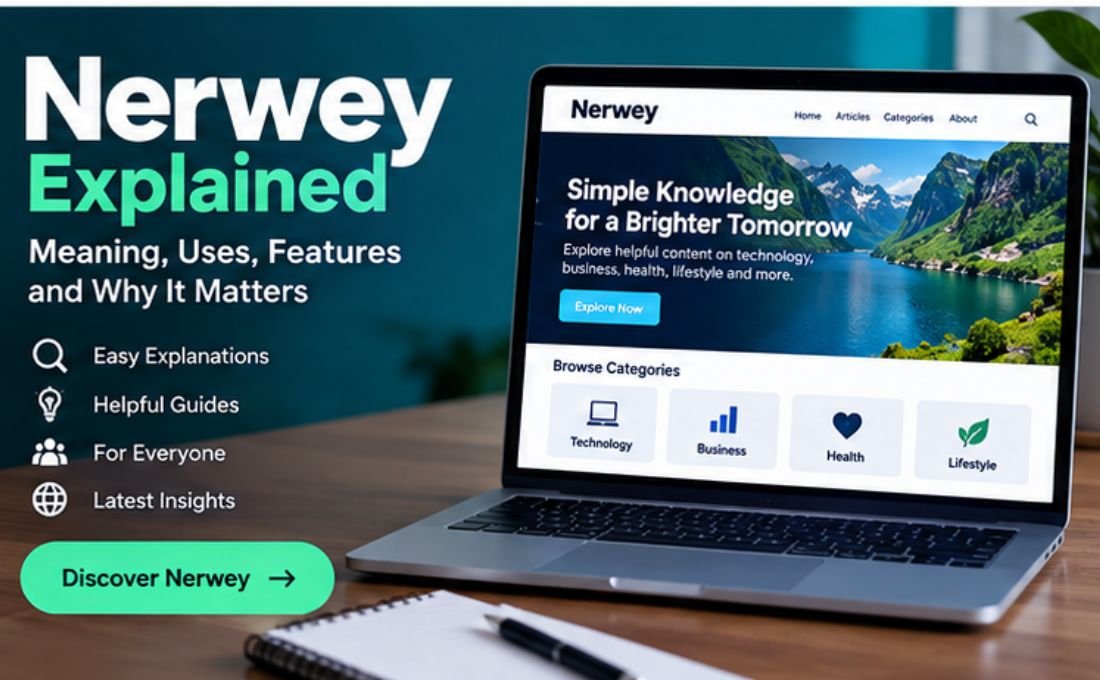
In this article, Nerwey refers primarily to the name used by Nerwey.com. The website displays articles organised into categories, with headlines, publication dates, author labels and archives.
That gives readers something concrete to examine. Its visible activity is publishing written content across several subjects.
The homepage reviewed included categories such as business, technology, digital marketing, education, health and lifestyle. It also displayed articles about topics ranging from animation tools to property management. Nerwey.com homepage
This does not establish every claim made about the website elsewhere. It does, however, provide a clear starting point: readers can visit it to browse articles.
What Does the Name Nerwey Mean?
A confirmed origin or established dictionary meaning for “Nerwey” was not identified during this research. In the context of the website, it functions as a name.
That is not unusual. A website name does not have to be an everyday word, and its spelling does not need to explain every subject the publisher covers.
Think of the difference between a shop’s name and the products on its shelves. The name identifies the shop; the products reveal what customers can find there.
The same approach works here. Rather than assigning Nerwey an invented meaning, look at the particular website or project using it.
Descriptions such as “a symbol of innovation” may be someone’s interpretation. They should not be confused with a documented explanation from the person who chose the name.
What Does Nerwey.com Say About Itself?
Nerwey.com’s About page describes a publishing project focused on accessible information. It lists technology, business, digital marketing, and health and lifestyle among its intended subjects.
The page also expresses an aim to make articles understandable to both beginners and experienced readers. These are the publisher’s stated goals, rather than an independent assessment of every article’s quality. Nerwey’s About page
This distinction is useful when reading any website introduction. An About page explains how the publisher wants to present itself.
To judge how well it delivers on those promises, you still need to examine the articles. Clear writing, accurate explanations and dependable sources are qualities demonstrated through the work itself.
What Can Readers Find on the Website?
The site’s broad subject range means different readers may arrive for different reasons. Someone might search for a software explanation, while another person might want a business-related article.
The following sections explain the general kinds of reading associated with those categories. They should not be treated as a promise that every possible topic is covered.
Technology and Digital Tools
Technology articles can help readers understand unfamiliar terms, software features or online services. A good introductory guide makes it clear what a tool does and who provides it.
However, publishing a guide about a tool does not mean the publisher built that tool. An article about video editing, for example, is separate from the software used to edit videos.
Keeping that distinction in mind helps prevent confusion about what Nerwey itself offers.
Business and Work
Business content may introduce readers to ideas about running an organisation, working with customers or understanding workplace processes.
The usefulness of an article depends partly on its scope. A general explanation may be a helpful introduction, while a specific decision may require more detailed information.
For example, a broad article about customer service can explain common approaches. It cannot automatically account for every business, customer group or local circumstance.
Digital Marketing
Digital marketing concerns how organisations communicate with people online. Articles in this area may discuss websites, search engines, content or social media.
Readers should distinguish an explanation from a performance promise. Learning about a marketing technique does not establish that it will produce a particular result for every website.
A useful article explains the conditions, limitations and reasoning behind its claims.
Lifestyle and General Subjects
A publisher covering several subjects can also include everyday topics beyond technology and business. That variety can make the website a place for casual browsing.
At the same time, a broad content range means expertise should be assessed article by article. A readable explanation in one category does not automatically establish specialist knowledge in another.
Is Nerwey an AI Tool?
The material reviewed did not establish Nerwey.com as a functioning AI product. Its visible pages supported the description of an article-publishing website.
This is narrower than saying that no product anywhere could use the name. Different organisations can use similar names, and websites can change over time.
The important question is whether there is direct evidence for the particular product being described. A working demonstration, clear documentation or a product page identifying the provider would help answer that question.
An article calling something an “advanced AI assistant” is not enough by itself. Readers need to see what the claimed assistant actually does.
Writing About AI Is Different From Providing AI
This is one of the simplest ways to understand the confusion.
Imagine a magazine publishing an article about cameras. The magazine does not become a camera manufacturer because it explains lenses and photography.
Likewise, a website can publish stories about artificial intelligence without offering its own AI system. The subject of an article and the service provided by its publisher are different things.
When assessing a claim about Nerwey, ask whether the page lets you use a tool or only read about one. That question can resolve much of the uncertainty.
It also helps avoid attaching another company’s features to the website discussing them.
Is Nerwey a Social Network?
The reviewed pages did not verify a dedicated Nerwey social network. The visible structure was mainly organised around published articles.
A social network usually centres on interaction between user accounts. Profiles, personal posts, connections between users and shared feeds are common features.
A publishing website may still have comments, sharing buttons or links to social media. Those additions do not necessarily make the website a social network in its own right.
For a reader, the practical question is simple: what can you actually do there? Browsing a publisher’s stories is a different experience from creating a profile and building a network of contacts.
Nerwey.com and Nerwey.org: Why the Address Matters
A separate website at Nerwey.org also uses the name. Its visible navigation includes subjects such as Norway, entertainment, fashion, sport, technology and business. Nerwey.org website
The matching name does not, on its own, prove shared ownership. Nor does a different domain ending prove that the sites are unrelated.
The ownership relationship was not established in the material reviewed. It is therefore better to identify the exact domain when discussing either website.
This matters in ordinary browsing. A statement about the content or features of Nerwey.com should not automatically be applied to Nerwey.org.
| What you are checking | Why the exact address matters |
|---|---|
| Articles and categories | Different sites may publish different material |
| Contact information | Each domain may list different contacts |
| Privacy information | Policies should be checked on the site you use |
| Product claims | A feature on one domain may not exist on another |
| Ownership | Similar names alone do not establish a connection |
Is Nerwey Another Name for Norway?
There is no verified basis here for treating Nerwey as an official alternative spelling of Norway.
Norway is the established English name of the Northern European country. Nerwey, in the context of your reference article, is a website-related name.
The two spellings resemble each other, which can lead to confusing search results. That resemblance does not make them interchangeable.
Context usually provides the answer. A page about Oslo or Norwegian geography is discussing Norway, while a page about Nerwey.com is discussing a particular website.
A website can also publish articles about Norway while using Nerwey as its name. The subject it covers still remains separate from the publisher’s identity.
Why Do Search Results Give Different Answers?
An unfamiliar name gives readers fewer clues than a familiar word. Without a widely established meaning, different pages may interpret it differently.
One writer may focus on the website. Another may repeat an AI-related description found elsewhere. A third may confuse the spelling with a place name.
The difficulty grows when a later article repeats an earlier claim without checking where it began. Repetition can make a statement look well supported even when the underlying evidence is thin.
This does not prove that every unusual claim is false. It means the number of pages repeating a claim is less important than the quality of the evidence behind it.
The most useful question is: “Can I follow this statement back to something that directly supports it?”
What Does the Word “Platform” Tell You?
“Platform” is a broad description. On its own, it does not explain whether a website publishes articles, sells products or provides software.
A publishing platform helps present content. A software platform allows users to perform tasks. A community platform centres on participation and interaction.
Sometimes a service combines several of these functions. But the word alone does not establish which features are present.
For Nerwey, describing the visible activity is more useful than relying on a broad label. Saying that a site publishes articles gives readers a clearer expectation than calling it an innovative digital platform.
How Useful Is Nerwey for Readers?
Its usefulness depends on the particular article and the question you want answered. A short explanation may be enough to understand an unfamiliar term.
More demanding questions need more support. If an article describes a specific product feature, it helps to compare the explanation with the product provider’s own documentation.
A practical way to read is to begin with one question. After finishing the article, ask whether you can answer it clearly in your own words.
If you still cannot explain the main idea, look for a better-supported or more detailed source. The goal is understanding, rather than simply reaching the end of the page.
How to Assess an Article Before Relying on It
You do not need to investigate an entire website every time you read a post. A few focused checks can help you judge the information in front of you.
Check the Date
Some subjects change quickly. An older guide may describe a feature, price or process that has since changed.
Also distinguish the publication date from the date of the event being discussed. A recently published page can still contain old information.
Look for the Original Source
When an article gives a number or describes an official announcement, check where that information came from.
A link to the original report or provider makes the claim easier to assess. A confident sentence without supporting evidence gives you less to work with.
Separate Facts From Opinions
A statement about a visible feature can often be checked directly. A statement that a service is “the best” depends on criteria and judgement.
Useful writing makes that difference clear. It explains why a conclusion was reached instead of asking readers to accept enthusiasm as evidence.
Notice What Is Missing
Sometimes the missing detail matters most. A product article may describe benefits while leaving out availability, restrictions or cost.
That does not settle whether the product is good or bad. It tells you which questions still need answers.
Does a Professional Website Design Prove Reliability?
A clean layout can make reading easier, but it cannot guarantee accuracy. Design and editorial quality are separate things.
Similarly, an About page can express good intentions without proving that every published statement has been checked. Trust develops through consistent, verifiable work.
For Nerwey, the available evidence supports describing the site’s publishing format. It does not support an unconditional claim that all content is accurate or that every linked service is dependable.
Readers should assess the relevant page and the action they intend to take. Reading an explanation requires a different level of confidence from relying on it for an important decision.
What Should Writers Avoid Claiming About Nerwey?
An accurate article should avoid attaching details that have not been established. These include invented founders, launch stories, user totals and technical capabilities.
Claims about exclusive algorithms or guaranteed results also need direct support. A name that sounds modern does not reveal how a supposed product works.
Writers should be equally careful about negative claims. Missing evidence is a reason to withhold a conclusion, not automatically a reason to accuse a website of wrongdoing.
Clear wording helps: describe what is visible, identify what the publisher says and state where verification remains incomplete.
Final Thoughts
Nerwey makes the most sense here as a name used by informational websites, with Nerwey.com visibly publishing articles across several categories. That is a concrete description readers can understand and check.
Claims that the name represents an AI assistant, social network or specialised software product need separate evidence. They should not be accepted simply because other articles repeat them.
For anyone discovering Nerwey for the first time, start with the exact website address and the content in front of you. Those details provide a firmer answer than the name alone.
FAQs
What is Nerwey?
In this context, Nerwey is the name associated with Nerwey.com, a website publishing articles across subjects including technology, business and digital marketing.
What does Nerwey mean?
A confirmed origin or established dictionary meaning was not identified. On the website, it functions as a name.
Is Nerwey an AI assistant?
The pages reviewed did not establish a working AI assistant offered by Nerwey.com. Publishing articles about AI does not prove that the website provides an AI product.
Is Nerwey a social media platform?
A dedicated social network was not verified. The reviewed pages mainly showed a publishing format with articles, categories and archives.
Are Nerwey.com and Nerwey.org the same organisation?
Their ownership relationship was not established. They should be discussed by their exact domain names unless reliable evidence connects them.
Is Nerwey the same as Norway?
No. Norway is a country, while Nerwey is the website-related name discussed in this article. Similar spelling does not make them the same subject.
Can I rely on every Nerwey article?
Each article should be assessed on its own evidence, date and subject. The existence of a website does not guarantee the accuracy of every page it publishes.
For more detailed celebrity-family biographies, hidden life stories, and interesting profiles behind famous names, visit Topper Magazine.
