

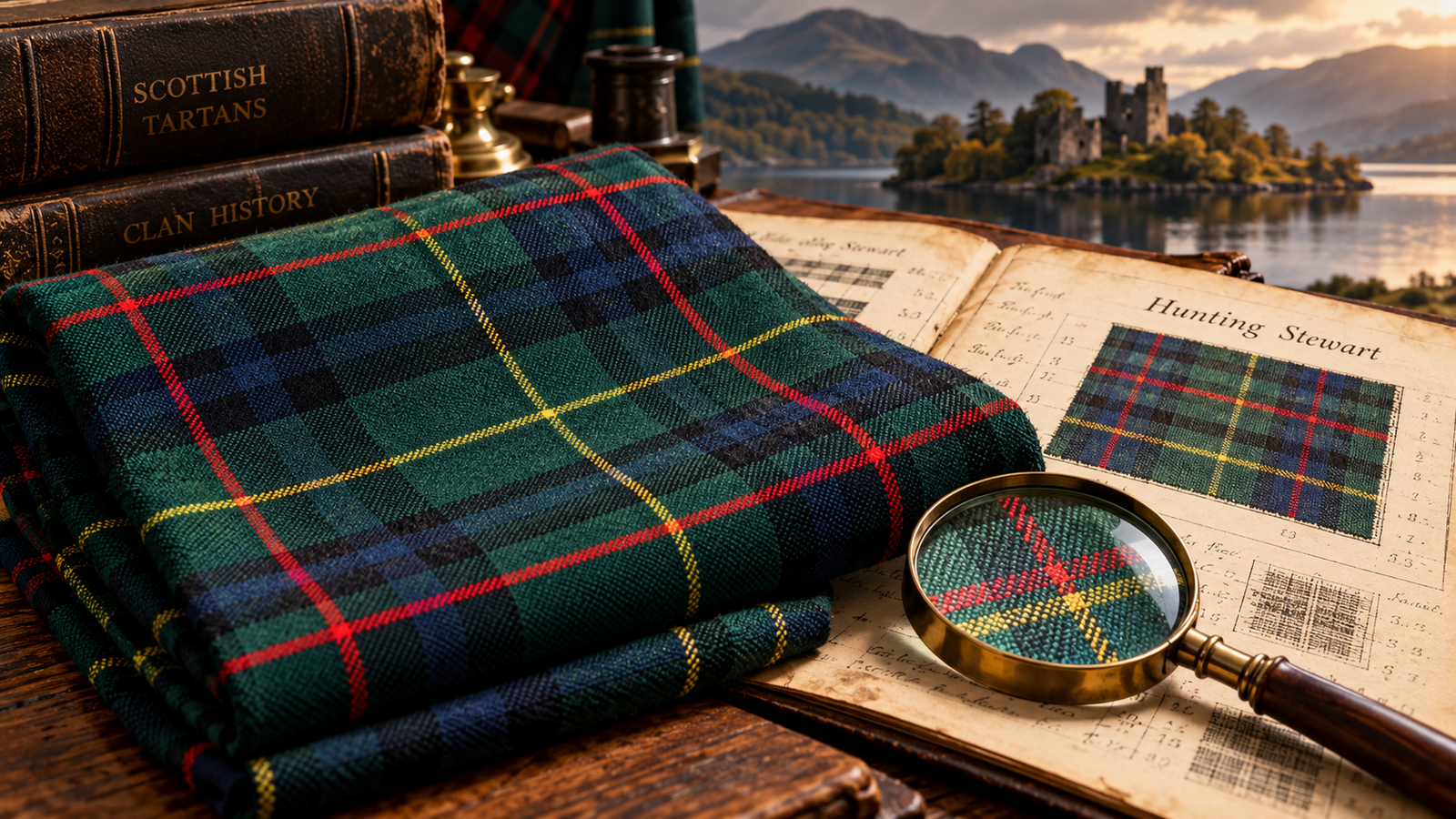
Every tartan is supposed to come with a story. A clan, a glen, a battle, a chief who wore it into exile. People who sell tartan are very good at these stories, and people who buy it enjoy them.
This is the story of a tartan that does not have one. It has a first appearance, a long silence, a false lead involving a prince, and a central puzzle nobody has solved. It is also, as it happens, one of the two tartans that tradition allows absolutely anyone to wear. Those facts may well be connected. The tartan is the Stewart Hunting tartan, better known to most people as Hunting Stewart.
The entry in the book
The trail starts in the village of Bannockburn, near Stirling, in the years after Waterloo.
The firm of William Wilson & Sons had been weaving tartan there since the 1760s, and by 1819 it more or less was the tartan industry. Wilsons had clothed the Highland regiments through the long years when tartan was banned for everyone else. When the ban was lifted in 1782 and the fashion for all things Highland began to build, they were ready with looms, dyes and a back catalogue. Their working records survive, and they are the single most important source for anyone trying to find out how old a tartan really is.
In 1819 the firm drew up what it called its Key Pattern Book, a master list of setts with exact thread counts, so that a weaver at any loom could reproduce any pattern. Some of the entries are named for clans. Some are named for towns, or regiments, or customers. Some just have numbers.
In those records is a pattern with a dark green ground, broken by bands of black and navy blue, with two fine overchecks: one red, one yellow. It is the sett the world now knows as Hunting Stewart.
That is the first anybody hears of it. There is no note of who asked for it, who designed it, or which of the many Stewart families it was meant for. It looks nothing like the famous Royal Stewart, the scarlet tartan of the royal house. It simply appears in a weaver’s book, fully formed, with no explanation.
The pattern that will not turn round
Look closely at the cloth and the mystery deepens, because Hunting Stewart breaks the first rule of tartan design.
Almost every tartan is a mirror. The weaver works through a sequence of coloured stripes until he reaches a pivot, then runs the same sequence backwards, then forwards again. The result is a pattern that reflects itself endlessly in both directions. It is why tartans look balanced, and why a kiltmaker can centre a garment on any pivot and have it look right.
Hunting Stewart has no pivots. The Scottish Register of Tartans puts it drily: the pattern “is unusual in that the half sett is not reversed.” The whole sequence just repeats, left to right, over and over. The practical effect is that the two fine lines alternate across the cloth. Red through the middle of one green block, yellow through the next, red, yellow, red, yellow, marching in one direction and never doubling back.
Was it a mistake? A weaver’s shortcut that stuck? A deliberate joke by someone at Wilsons who was tired of mirrors? Nobody knows. Kiltmakers have been quietly cursing it for two hundred years, since they have to decide which line goes at the centre of the apron and how to fold the pleats so the rhythm survives at the back. Wearers, on the whole, love it. There is a restlessness in the cloth that symmetrical tartans lack.
The false lead
At some point a story attached itself to the pattern, as stories do. It said that this was the tartan Prince Charles Edward Stuart wore in the hills during the rising of 1745. You can still find it repeated on shop websites.
There is nothing in it. No portrait of the prince shows this sett. No inventory, no letter, no surviving scrap of cloth connects it to him or to anyone else in the ’45. The pattern surfaces in a commercial pattern book more than seventy years after Culloden, in an era when weavers were naming new designs after anything romantic that came to hand. The likeliest truth is the dullest. Somebody at Bannockburn designed a handsome dark tartan around 1800, and the Stewart name was good for business.
After 1819 the trail goes cold for decades. The tartan was evidently being woven and sold, but it did not appear in any of the great illustrated books of clan tartans that came out through the middle of the century. It finally reached print in 1886, when James Grant included it in The Tartans of the Clans of Scotland, sixty-seven years after Wilsons wrote it down.
Then, at the start of the twentieth century, it acquired some real history at last. The Royal Scots, the oldest infantry regiment in the British Army, adopted Hunting Stewart for their tartan trews. A pattern with no past had found a home. Today it is one of the commonest cloths in kilts for men, for the plain reason that nobody can tell a wearer he has no right to it.

Everybody’s tartan
Here is the strangest part. By then, without anyone deciding it, Hunting Stewart had become common property.
Tartan etiquette is custom and not law, but the custom is fairly settled. A clan tartan says you belong, by blood or name or allegiance, to a particular family. A district tartan belongs to a place. A very few are restricted: the Balmoral is reserved for the royal family. And then there are the universal tartans, which anyone may wear without explanation. Writers on the subject have traditionally named two. One is Black Watch, which began as an army uniform. The other is Hunting Stewart.
Why this one? The register’s own notes give up: there is, they say, “no reliable explanation of why the Hunting Stewart should be regarded as a ‘General’ tartan.”
Perhaps the answer is the absence of an answer. A tartan with a known founder, a known glen and a jealous chief can be owned. A tartan that walked out of a weaver’s ledger with no parents belongs to whoever picks it up. Two centuries of people with no clan of their own have picked it up, and by now their use is the tradition.
Retailers usually file it with the rest of the family. A supplier’s page for Stewart Hunting tartan and its relations will carry Royal Stewart, Dress Stewart and Black Stewart beside it, all made to measure as kilts, skirts, waistcoats, trousers and scarves, or sold by the yard in Modern, Ancient and Weathered colours. Put them side by side and the hunting sett’s advantage is plain. It is the one that goes with everything.
Marek’s first kilt
Take a man called Marek. He is invented, but you have met him.
He is thirty-four and writes software in Denver. His grandparents came from Poland. His closest friend from college, a MacGregor, is getting married in September and has asked the groomsmen to wear kilts. The MacGregor will be in his clan’s red. The others have a Campbell grandmother and a Fraser great-uncle to lean on. Marek has nobody.
He spends an evening reading and comes away with two discoveries. The first is Hunting Stewart, the tartan that asks no questions. Dark green, navy, black, a thread of red and a thread of yellow. It will look right beside the groom’s scarlet without competing with it. Nobody at the reception will ask him what gives him the right.
The second discovery is that he likes the garment more than he expected to, and that the word kilt now covers a good deal more than the eight yards of pleated wool he is ordering for the wedding. There is a five-yard casual version, lighter and cheaper, that people wear to Highland games and rugby matches. And there is a whole family of modern kilts for men built as workwear: heavy cotton, cargo pockets, belt loops, snap closures, D-rings at the hip, no sporran needed. They come in black and khaki and olive, in hi-vis and camouflage, in gothic styles covered in hardware. The ones that catch his eye are the hybrids, where a plain cotton front carries a back of tartan pleats. He could have Hunting Stewart in those pleats. He could wear it to a festival, on a hike, to the brewery on a Saturday.
He orders the formal kilt first. He learns that it sits at his navel and not at his hips, that his kilt waist is three inches bigger than his jeans, and that the length is found by kneeling on the floor and measuring from waist to ground. He learns that the good makers cut every kilt to those three numbers instead of selling small, medium and large.
The wedding goes well. In the photographs he looks as if he has been wearing one all his life. In October he orders the hybrid.
Case not closed
The file on Hunting Stewart is still open, and will probably stay that way. We know where it was first written down and when it was first printed. We do not know who drew it, who it was meant for, why it refuses to mirror, or how it slipped its moorings and became a tartan for the whole world.
Most of the grand stories told about tartans turn out, on inspection, to be a good deal younger than they claim. This one never claimed anything. It is a dark green cloth that a weaver made because it was handsome and that people have gone on wearing for the same reason. For a man buying his first kilt, with no clan to call on and no wish to invent one, that is a better pedigree than most.
