

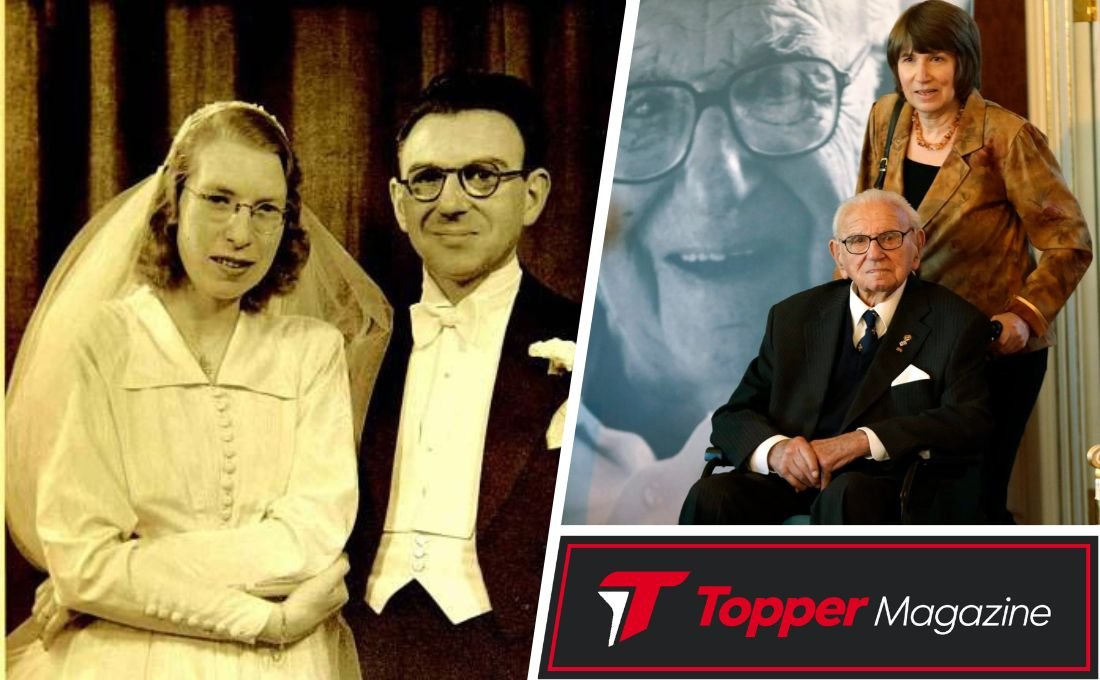
Grete Winton, born Grete Gjelstrup, was the Danish wife of British humanitarian Nicholas Winton. She lived quietly beside him for decades without fully knowing how important his actions in 1939 would become to history. Then, in the late 1980s, Grete came across papers connected with the children Nicholas had helped escape Nazi-occupied Czechoslovakia—a discovery that played an important part in bringing his remarkable wartime work to wider public attention.
Grete was much more than the wife of a famous humanitarian. She was a Danish woman who met Nicholas after World War II, built a family with him in England, experienced heartbreaking loss, and shared more than 50 years of marriage with a man whose wartime story eventually touched millions.
Grete Winton Quick Bio
| Detail | Information |
|---|---|
| Full Name | Grete Winton |
| Birth Name | Grete Gjelstrup |
| Born | December 21, 1919 |
| Birthplace | Denmark |
| Nationality | Danish |
| Famous For | Wife of Sir Nicholas Winton |
| Husband | Nicholas Winton |
| Married | 1948 |
| Children | Three |
| Known Children | Barbara, Nicholas and Robin |
| Died | August 28, 1999 |
| Place of Death | Slough, Berkshire, England |
| Age at Death | 79 |
| Historical Importance | Helped bring Nicholas Winton’s wartime rescue records to wider attention |
IMDb records Grete’s birth as December 21, 1919, in Denmark and her death on August 28, 1999, in Slough, Berkshire.
Who Was Grete Winton?
Grete Winton was the longtime wife of Sir Nicholas Winton.
Today, Nicholas is remembered around the world for helping organize the rescue of hundreds of mostly Jewish children from Czechoslovakia shortly before World War II.
But for much of his adult life, his wartime activities were not widely known.
Grete shared his life long before television audiences knew his story.
She knew Nicholas as a husband, father, community volunteer, and working professional.
That makes her part of a fascinating question.
What is it like to discover that the person you have lived beside for decades once played a remarkable role in saving hundreds of lives?
For Grete, that question became real.
Grete Winton Was Born in Denmark
Grete was born Grete Gjelstrup in Denmark on December 21, 1919.
Her early years remain far less documented than Nicholas’s.
That is understandable.
Grete did not grow up expecting international attention.
She was a private person, and most surviving biographies focus on the period after she met Nicholas.
Her Danish background would eventually bring her to Paris, where a chance professional connection changed the course of her life.
How Did Grete Meet Nicholas Winton?
After World War II, Nicholas worked in Paris for the International Bank for Reconstruction and Development.
Grete was a Danish secretary working for his employer.
That was where they met.
It was a very different chapter from Nicholas’s wartime rescue work.
The war had ended.
Europe was rebuilding.
Nicholas was developing a new career.
And Grete entered his life without the world-famous heroic reputation that would surround him many decades later.
Their relationship developed, and the couple married in 1948.
Grete Gjelstrup Became Grete Winton
Marriage gave Grete a new surname and eventually a new home.
Nicholas and Grete moved to Maidenhead in Berkshire, England.
There they built the kind of family life that, from the outside, probably appeared fairly ordinary.
Nicholas worked.
Grete raised a family with him.
They became involved with their community.
Nothing about their everyday home life immediately suggested that Nicholas had once been involved in an extraordinary rescue operation before the war.
Nicholas Winton’s Wartime Rescue
To understand why Grete’s later discovery became so important, we need to understand what Nicholas had done.
In 1938 and 1939, conditions in Nazi-controlled Europe were becoming increasingly dangerous, particularly for Jewish families.
Nicholas became involved in efforts to help children leave Czechoslovakia and travel to safety in Britain.
He and others worked to arrange permits, foster homes, funding, and transportation.
The United States Holocaust Memorial Museum says Nicholas’s scrapbook documented 664 children brought to Britain on transports he organized. Later research identified five additional people who came on a Winton-financed transport, producing the often-cited total of 669.
It was an enormous humanitarian achievement.
Yet for decades, it received relatively little public attention.
Did Grete Know About Nicholas Winton’s Rescue Work?
Not in the way the world later came to know it.
Nicholas did not spend his family life telling everyone around him that he was a hero.
The Holocaust Memorial Day Trust notes that he did not deliberately hide what he had done, but he also did not view his actions as something extraordinary. His rescue work simply remained little known to the wider public for many years.
That distinction is important.
Some simplified versions of the story say Nicholas kept everything completely secret.
The reality is more subtle.
The records existed.
Nicholas had even been trying to find an appropriate home for them.
But their significance had not yet become widely understood.
Then Grete encountered the material.
The Scrapbook That Changed Everything
This is the moment that made Grete Winton an unforgettable part of Nicholas’s story.
In the late 1980s, Grete came across a scrapbook containing documents connected to Nicholas’s 1939 rescue activities.
The material included photographs, names, letters, and records relating to the children.
Imagine opening an old collection of papers and gradually understanding what you were looking at.
These were not ordinary family documents.
They were evidence of an operation that had helped children escape enormous danger.
Grete understood that the story deserved attention.
Did Grete Find the Scrapbook in the Attic?
This is how the story is often told.
IMDb says Grete discovered an old case in the attic in 1988 containing papers detailing Nicholas’s role in saving children. Biography.com similarly describes her stumbling across an old scrapbook containing letters, photographs, and travel documents.
Other authoritative accounts provide a little more context.
The Holocaust Memorial Day Trust says Nicholas was already trying to find an archive or museum for his papers around this period.
So it is safest to say Grete’s discovery and attention to the documents helped move the story toward wider recognition rather than suggesting that Nicholas had intentionally hidden every trace of it from everyone.
How the Story Reached the Public
The papers eventually came to the attention of people who understood their historical importance.
Biography.com reports that, with Nicholas’s consent, Grete passed the scrapbook to a Holocaust historian.
From there, interest grew.
Newspaper coverage followed.
Then came one of the most emotional moments in British television history.
Nicholas was invited onto the BBC program That’s Life!.
He did not fully understand what was waiting for him.
The Famous That’s Life! Reunion
During the television appearance, Nicholas was surrounded by adults who had once been among the children helped by the rescue effort.
At one famous moment, the presenter asked whether anyone in the audience owed their life to Nicholas Winton.
People around him stood up.
Nicholas looked around and realized who they were.
The scene became one of the best-known television moments connected with Holocaust remembrance and humanitarian courage.
The Holocaust Memorial Day Trust says many of the rescued children had not previously known who had organized their escape and were deeply moved to meet him.
And Grete had helped bring the documents behind that story into public attention.
Grete Winton and Nicholas Winton’s Children
Grete and Nicholas built a family together after marrying.
Authoritative local-history and Holocaust remembrance sources say they had three children.
Their children included Barbara, Nicholas and Robin.
Their daughter Barbara Winton later became especially important in preserving her father’s story.
She wrote If It’s Not Impossible…: The Life of Sir Nicholas Winton, a biography exploring his life and work.
That meant the next generation of the family continued telling the story that had once remained largely outside public view.
The Heartbreaking Death of Their Son Robin
Grete and Nicholas’s family life also contained deep sadness.
Their son Robin died from meningitis while still a young child.
Visit Windsor says Robin died aged six, while the Holocaust Memorial Day Trust describes him as dying the day before his seventh birthday.
Losing a child is one of the most painful experiences any parents can face.
For Nicholas and Grete, the tragedy also influenced their later community involvement.
Nicholas became closely associated with what developed into Maidenhead Mencap and served as president for more than 40 years.
Their family experience therefore became connected with another chapter of service.
Life in Maidenhead
Grete and Nicholas settled in Maidenhead.
Their home there became the center of a long marriage and family life.
Nicholas continued working and later devoted considerable energy to charity and community causes.
He became involved with Mencap and the Abbeyfield movement, which supported older people.
In 1983, he was appointed MBE for his work helping establish Abbeyfield homes for elderly people in Britain.
This happened before his wartime rescue work became internationally famous.
In other words, service was already a major part of his later life.
Grete lived beside that quieter form of public contribution too.
Grete Was Not a Celebrity Wife
It would be misleading to imagine Grete living like the spouse of a modern celebrity.
For most of their marriage, Nicholas was not internationally famous.
He had a respected professional and community life, but he was not surrounded by cameras everywhere he went.
Grete therefore spent most of her life as a wife and mother rather than as a public personality.
Only later did worldwide recognition transform the way people looked at her husband.
That helps explain why reliable details about Grete’s own career and daily life remain limited.
Was Grete Winton on Television?
Yes, although she was not a television personality.
IMDb credits Grete with appearing as herself in a 1988 episode of That’s Life! and in the documentary The Power of Good: Nicholas Winton.
These appearances were connected with Nicholas’s story.
They did not represent an entertainment career.
Grete’s importance came from her real life, not from performing for cameras.
How Long Were Grete and Nicholas Winton Married?
Their marriage lasted more than 50 years.
They married in October 1948 and remained together until Grete’s death in August 1999.
That means Grete knew Nicholas across many different stages of life.
She knew him as a post-war professional.
She knew him as a young husband.
She raised children with him.
She lived through family tragedy beside him.
And eventually she watched the world discover the remarkable work he had carried out before they even met.
Was Grete Winton Knighted?
Grete herself was not knighted.
Nicholas was knighted in 2003 for services to humanity connected with the rescue work.
Because a knight’s wife may traditionally use the courtesy title “Lady,” Grete is sometimes called Lady Grete Winton retrospectively in articles.
However, she had already died in 1999, four years before Nicholas received his knighthood.
That timeline is important when describing her accurately.
Grete Winton’s Death
Grete died on August 28, 1999, in Slough, Berkshire, England.
She was 79 years old.
Her death ended a marriage that had lasted for more than half a century.
Nicholas lived for another 16 years.
He died in 2015 at the age of 106.
By then, his story had become internationally famous.
Nicholas Winton After Grete’s Death
The years after Grete’s death brought even greater recognition for Nicholas.
He received numerous honors.
The Holocaust Memorial Day Trust notes that these included a knighthood, the Freedom of the Cities of Prague and London, and the Czech Republic’s Order of the White Lion.
Yet Nicholas repeatedly resisted the idea that he was an extraordinary hero.
He believed people should simply act when they could help.
That humility became an important part of his public image.
Grete’s Role in Preserving the Winton Story
Grete did not organize the 1939 rescue.
She was not in Prague working beside Nicholas at the time.
In fact, they had not yet met.
Her importance came much later.
She recognized the value of the surviving records and helped them reach people who could bring the story to wider attention.
Without preserved documents, history can disappear surprisingly quickly.
Names get forgotten.
Photographs are lost.
Personal memories fade.
Grete’s connection to the scrapbook helped ensure that did not happen here.
Was Nicholas Winton Really Responsible for Saving 669 Children?
The famous number is 669, and it appears throughout biographies and memorials.
However, historical research has added useful detail.
The U.S. Holocaust Memorial Museum says Winton’s scrapbook records 664 children transported through efforts he organized, while researchers later identified another five on a Winton-financed transport, bringing the figure to 669. The museum also notes that the total may not yet be completely certain because some rescued people may remain unidentified.
That does not reduce Nicholas’s achievement.
It simply shows how careful historical research works.
Grete Winton’s Net Worth
There is no reliable public figure for Grete Winton’s personal net worth.
She was not a celebrity entrepreneur or entertainer whose wealth was regularly reported.
Any modern website offering a precise number would therefore need strong evidence.
No trustworthy financial record establishes a verified fortune for Grete.
Her legacy is historical and personal rather than financial.
Where Was Grete Winton From?
Grete was Danish.
She was born in Denmark in 1919 and later met Nicholas while working in Paris.
After marrying, she made her life in Britain.
This gave the Winton family an interesting international background.
Nicholas was British.
Grete was Danish.
They met in France.
And Nicholas’s greatest-known humanitarian work had taken place in connection with Czechoslovakia.
Their story crossed European borders long before it became famous.
Grete Winton in One Life
Grete’s story can look small beside Nicholas’s enormous historical legacy.
But that misses what makes it interesting.
She spent more than 50 years beside him.
She became the mother of his children.
She endured the loss of a young son.
She watched her husband’s community work continue for decades.
Then she played a role in bringing old records into the light.
Suddenly the quiet man she had married was being thanked by people whose lives had changed because of work he had done half a century earlier.
That must have been an extraordinary transformation to witness.
Interesting Facts About Grete Winton
Grete Winton was born Grete Gjelstrup in Denmark on December 21, 1919.
She met Nicholas Winton in Paris after World War II while working as a secretary.
They married in 1948.
The couple had three children.
Their son Robin died from meningitis while still a child.
Grete came across records connected with Nicholas’s 1939 rescue work in the late 1980s.
She appeared on That’s Life! in 1988.
Grete and Nicholas remained married until her death in 1999.
She died at age 79.
Nicholas was knighted several years after Grete’s death.
Why Grete Winton’s Story Still Matters
History is often remembered through one famous name.
But important stories usually involve many people.
Grete did not become internationally celebrated like Nicholas.
Still, she became part of the process through which his work was preserved and understood.
Her story also reminds us that history can sit quietly inside ordinary homes.
An old scrapbook can look like forgotten paperwork.
A list can look like names on a page.
But behind those names were children.
Behind those children were entire families and future generations.
That is what made the records Grete encountered so powerful.
Final Thoughts
Grete Winton’s life was deeply connected with one of the most moving humanitarian stories of the twentieth century, but she entered that story long after the rescue itself.
Born in Denmark in 1919, Grete met Nicholas Winton in post-war Paris and married him in 1948. They moved to Maidenhead, raised three children, experienced the devastating loss of their son Robin, and built a marriage lasting more than half a century.
Then came the discovery that changed how the wider world saw Nicholas.
Old papers and a scrapbook revealed the details of the children he had helped escape from Czechoslovakia before World War II. Grete helped connect those records with people who understood their historical importance, contributing to the chain of events that brought Nicholas’s story to public attention.
Grete died in 1999, before Nicholas received some of his greatest honors.
Yet her place in the story remains special.
She was the woman who shared his ordinary life—and helped the world rediscover an extraordinary chapter from it.
FAQs About Grete Winton
Who was Grete Winton?
Grete Winton was the Danish wife of British humanitarian Sir Nicholas Winton.
What was Grete Winton’s maiden name?
Her birth name was Grete Gjelstrup.
When was Grete Winton born?
She was born on December 21, 1919, in Denmark.
How did Grete Winton meet Nicholas Winton?
They met in Paris after World War II while Nicholas worked for the International Bank for Reconstruction and Development and Grete worked as a Danish secretary.
When did Grete and Nicholas Winton marry?
They married in 1948.
How many children did Grete and Nicholas Winton have?
They had three children.
What happened to their son Robin?
Robin died from meningitis while still a young child.
Did Grete Winton discover Nicholas Winton’s scrapbook?
Grete encountered the collection of documents connected with Nicholas’s wartime rescue work in the late 1980s. Those materials helped bring the story to wider public attention.
How many children did Nicholas Winton help rescue?
The commonly cited number is 669. The U.S. Holocaust Memorial Museum explains that 664 were recorded in Winton’s scrapbook and five more were later identified on a Winton-financed transport.
When did Grete Winton die?
Grete died on August 28, 1999, in Slough, Berkshire, England.
How old was Grete Winton when she died?
She was 79 years old.
How long were Grete and Nicholas Winton married?
They were married for more than 50 years, from 1948 until Grete’s death in 1999.
Was Grete alive when Nicholas Winton was knighted?
No. Grete died in 1999, while Nicholas received his knighthood in 2003.
For more detailed celebrity-family biographies, hidden life stories, and interesting profiles behind famous names, visit Topper Magazine.
