

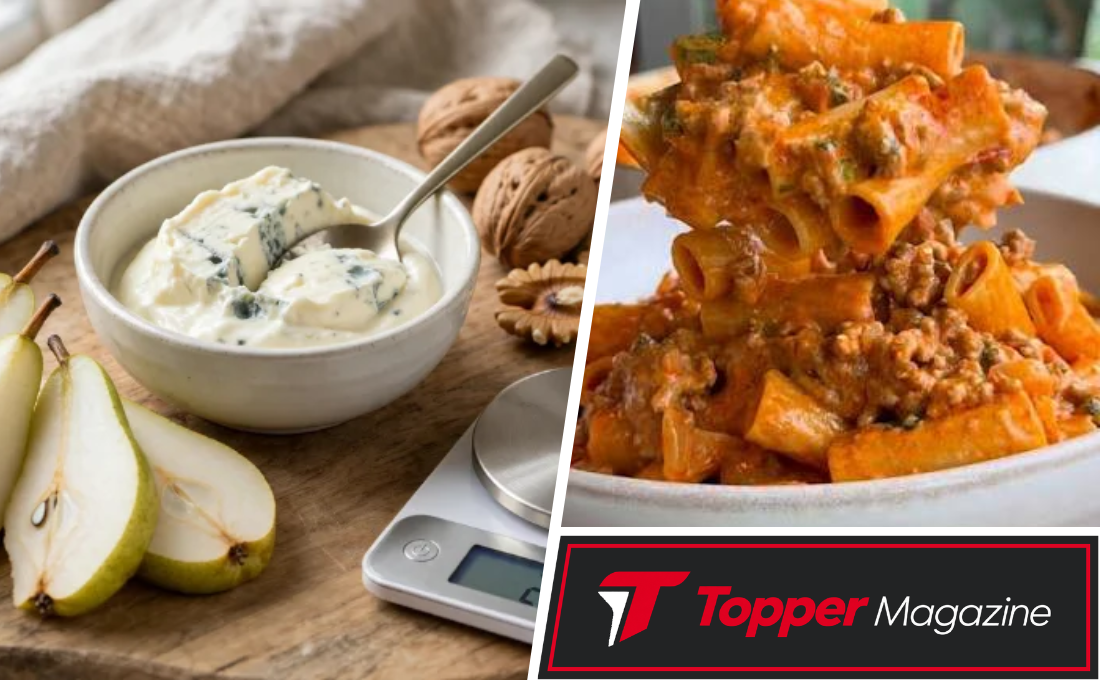
Masgonzola sounds like the name of a mysterious Italian cheese, but the story is much simpler—and more delicious. The name is commonly used for a creamy combination of Gorgonzola and mascarpone, bringing together the bold blue-cheese character of Gorgonzola with the smooth, buttery softness of mascarpone. Recipe publisher Betty Bossi directly describes Masgonzola as “Mascarpone-Gorgonzola,” while Italy’s official Gorgonzola consortium confirms that Gorgonzola itself is a protected Italian DOP cheese.
At first glance, it can look unusual. You may see creamy white sections sitting beside blue-green veins, almost as if someone has stacked two completely different cheeses together.
That is basically what makes Masgonzola interesting.
It can be strong without feeling too sharp, creamy without being boring, and rich enough that even a small amount can completely change a dish.
So, what exactly is Masgonzola? Is it a real cheese? Where does its strange name come from? And what should you actually do with it?
Here is the simple answer.
Quick Facts About Masgonzola
| Detail | Information |
|---|---|
| Name | Masgonzola |
| Main ingredients | Mascarpone and Gorgonzola |
| Type | Creamy cheese combination/specialty |
| Texture | Soft, rich and creamy |
| Main flavor | Buttery, tangy, salty and mildly blue |
| Milk allergen | Yes |
| Best used for | Pasta, risotto, bread, pizza, sauces and appetizers |
| Related cheese | Gorgonzola |
| Protected as its own DOP cheese? | No separate Masgonzola DOP established |
| Best storage | Refrigerated |
What Is Masgonzola?
Masgonzola is generally a combination of mascarpone and Gorgonzola cheese.
Mascarpone is famous for its thick, creamy texture and very mild flavor. Gorgonzola goes in almost the opposite direction. It is an Italian blue cheese with noticeable blue-green veins and a much stronger taste.
Put the two together and something interesting happens.
The mascarpone softens the power of the Gorgonzola. Meanwhile, Gorgonzola stops the mascarpone from tasting too plain.
You end up with a cheese that can be creamy, salty, tangy, buttery and slightly sharp at the same time.
Betty Bossi recipes repeatedly use the term Masgonzola for Gorgonzola combined with mascarpone, including recipes for dates, blinis and risotto. Its risotto recipe even says that Masgonzola can replace separate portions of Gorgonzola and mascarpone.
Where Does the Name Masgonzola Come From?
The name looks strange until you break it apart.
Mas likely comes from mascarpone.
Gonzola comes from Gorgonzola.
Put them together and you get:
Mas + Gonzola = Masgonzola.
It works almost like a food nickname.
However, people should be careful about repeating dramatic stories about an ancient Masgonzola tradition or claiming that it is an old protected Italian cheese with its own centuries-long history.
Reliable culinary usage points instead toward the term being used for the mascarpone-Gorgonzola combination.
There does not appear to be a clearly documented single inventor behind the name.
Is Masgonzola the Same as Gorgonzola?
No.
This is probably the biggest point of confusion.
Traditional Gorgonzola is its own famous Italian blue cheese. It has protected designation status in Europe and must meet established production requirements to be sold under the protected Gorgonzola name.
Masgonzola is different because mascarpone is added to the equation.
Imagine tasting a spoonful of something very spicy and then mixing it with something mild and creamy. The original flavor does not disappear, but it becomes smoother and easier for some people to enjoy.
That is roughly the role mascarpone plays here.
The Gorgonzola brings personality.
The mascarpone brings softness.
What Does Masgonzola Look Like?
Its appearance can depend on how the product is prepared.
Some versions may look almost blended together. The white mascarpone and blue-veined cheese become one creamy mixture.
Other versions can have visible layers.
Imagine cutting through a small cheese cake and finding sections of white mascarpone between pieces of blue-veined Gorgonzola.
That layered look can make Masgonzola especially attractive on a cheese board.
It also immediately tells you that you are dealing with something richer than ordinary blue cheese.
What Does Masgonzola Taste Like?
This is where things get interesting.
Gorgonzola can have a powerful flavor. Depending on the style and maturity, you may notice saltiness, tanginess and the unmistakable taste associated with blue cheese.
Mascarpone is much gentler.
It is creamy, slightly sweet and rich.
When those two meet, Masgonzola usually becomes less aggressive than eating a strong blue cheese alone.
The first thing you may notice is creaminess.
Then comes the Gorgonzola.
It can give you a salty and savory kick, followed by the rich dairy feeling of the mascarpone.
For someone who thinks ordinary blue cheese is too powerful, this combination may be easier to approach.
Is Masgonzola a Real Cheese?
Yes, the term is genuinely used in food and recipes.
But there is an important difference between saying Masgonzola exists and saying Masgonzola is a formally protected cheese variety like Gorgonzola.
Those are not the same thing.
For example, Betty Bossi describes Masgonzola as a soft Italian cheese consisting of alternating layers of Gorgonzola and mascarpone in one of its recipe publications.
Gorgonzola itself has formal DOP protection.
Masgonzola does not have a separate protected designation identified by the Gorgonzola consortium.
So the simplest description is:
Masgonzola is a Gorgonzola-and-mascarpone cheese specialty rather than an entirely separate protected cheese family.
Why Mix Mascarpone With Gorgonzola?
Because they solve each other’s problems.
Gorgonzola is full of flavor, but some people find it too strong.
Mascarpone is wonderfully creamy, but it does not have the same bold savory punch.
Mixing them gives you balance.
It is a little like adding milk to strong coffee.
You can still taste the coffee, but the drink becomes smoother.
Masgonzola follows the same basic idea.
You keep the personality of blue cheese while adding the silky richness of mascarpone.
How Is Masgonzola Made?
There is not necessarily one universal recipe that every producer must follow under the Masgonzola name.
At its simplest, the idea involves combining mascarpone and Gorgonzola.
Some products may be layered.
Others may be mixed more thoroughly.
At home, you could create a similar flavor by gently mixing softened Gorgonzola with mascarpone until you reach the strength and texture you want.
A person who loves powerful cheese could use more Gorgonzola.
Someone who wants a softer taste could increase the mascarpone.
That flexibility is part of the appeal.
Masgonzola vs Mascarpone
These two are very different.
Mascarpone is smooth, mild and extremely creamy.
It is probably most famous for its role in desserts such as tiramisu, but it can also appear in savory cooking.
Masgonzola has a much stronger personality because Gorgonzola is involved.
Think of mascarpone as a blank creamy canvas.
Masgonzola takes that canvas and paints blue-cheese flavor across it.
Masgonzola vs Gorgonzola
This comparison is even easier.
Gorgonzola generally gives you a more direct blue-cheese experience.
Masgonzola adds mascarpone, making the result richer and often gentler.
If you already love strong blue cheese, you may prefer straight Gorgonzola.
If you want something smoother to spread on bread or melt into pasta, Masgonzola can be especially useful.
Neither one is automatically “better.”
They simply do different jobs.
How Can You Eat Masgonzola?
This cheese is surprisingly flexible.
You do not need a complicated recipe.
One of the easiest options is simply spreading it on warm bread.
The heat can soften the cheese slightly, creating a rich topping without much work.
Crackers work too.
Add sliced pear, fig or grapes and you have something that feels much fancier than the effort required.
Betty Bossi has also used Masgonzola in several different dishes, from stuffed dates to blinis, demonstrating how easily the combination can move between appetizers and richer meals.
Masgonzola With Pasta
Pasta may be one of the easiest places to use it.
Because the cheese is already soft and creamy, it can melt into hot pasta beautifully.
You can cook your pasta, save a little pasta water and then stir in some Masgonzola.
The heat begins melting the cheese.
A splash of pasta water can help turn it into a smoother sauce.
Add black pepper and you already have the beginning of a simple dinner.
Mushrooms can work especially well because their earthy flavor can handle the richness of blue cheese.
Spinach is another easy partner.
Masgonzola in Risotto
Risotto and Masgonzola are almost made for each other.
Risotto is already creamy.
Adding Masgonzola pushes that creaminess even further while bringing stronger savory notes.
Betty Bossi’s Gorgonzola risotto combines Gorgonzola and mascarpone and specifically suggests using 200 grams of Masgonzola instead of the two separately.
The best part?
You normally do not need to add the cheese at the beginning.
Stirring it in near the end allows it to melt through the hot rice while keeping its flavor noticeable.
Masgonzola on Pizza
Blue cheese on pizza is not for everyone.
But Masgonzola can make the idea less intimidating.
Instead of hitting you with nothing but strong blue-cheese flavor, the mascarpone makes each bite creamier.
You could pair it with ingredients such as mushrooms, spinach, onion, pear or walnuts.
Just remember that Masgonzola is rich.
You usually do not need huge amounts.
A few well-placed pieces can be enough.
Masgonzola With Bread and Focaccia
Here is perhaps the easiest meal of all.
Take warm focaccia.
Slice it.
Spread Masgonzola inside.
Done.
Betty Bossi even suggests a focaccia variation spread with Masgonzola, described as Gorgonzola with mascarpone.
Add rocket leaves or sliced vegetables if you want more freshness.
That combination of warm bread and melting creamy cheese can be difficult to beat.
What Foods Pair Well With Masgonzola?
Rich cheese often becomes more interesting when something sweet, fresh or crunchy joins it.
Pears are an obvious example.
Their gentle sweetness can contrast nicely with the salty cheese.
Figs can work for the same reason.
Walnuts provide crunch.
Honey adds sweetness.
Rocket brings a peppery freshness.
Mushrooms offer earthiness.
You can even experiment with apples or grapes.
The goal is balance.
If your cheese is rich and salty, add something that makes the bite feel lighter or sweeter.
Is Masgonzola Healthy?
Calling any single food simply “healthy” or “unhealthy” can be misleading.
Masgonzola is a rich dairy food.
Because mascarpone and Gorgonzola both contain significant amounts of fat, Masgonzola can be calorie-dense.
It also provides protein and calcium as part of its dairy content, but the exact nutrition will depend on the product, recipe and ratio of the two cheeses.
Portion size matters.
A small amount can add a lot of taste.
You do not need to cover your whole plate with it to enjoy the flavor.
People following medically restricted diets—especially those limiting sodium, saturated fat or certain dairy products—should check the nutrition label of the exact product they are eating.
Does Masgonzola Contain Milk?
Yes.
Both mascarpone and Gorgonzola are dairy products.
Anyone with a milk allergy should therefore treat Masgonzola as a milk-containing food.
People who are lactose intolerant have different levels of tolerance, so they should not assume that a mixed cheese will automatically suit them.
Checking the packaging is always the safest move.
How Should You Store Masgonzola?
Keep it refrigerated.
Once opened, protect it well from air and from picking up other refrigerator smells.
An airtight container or proper cheese wrapping can help.
The manufacturer’s storage instructions should take priority because commercial Masgonzola-style products can differ in packaging and composition.
If the cheese develops an unexpected smell, texture or appearance that seems unrelated to the normal blue mold of Gorgonzola, do not simply assume it is fine because blue cheese already contains mold.
When unsure, discard it.
Can You Make Masgonzola at Home?
You can certainly make a Masgonzola-style mixture at home.
You only need good mascarpone and Gorgonzola.
Let them soften slightly in the refrigerator-safe preparation process, then combine them according to the taste you want.
For a mild result, use more mascarpone.
For a stronger blue-cheese punch, use more Gorgonzola.
You could blend them until smooth or create separate layers.
Then refrigerate the mixture properly before serving.
It is one of those foods where a simple experiment can teach you more than a complicated recipe.
Why Are More People Searching for Masgonzola?
The name itself creates curiosity.
Most people already recognize “Gorgonzola.”
Then they see “Masgonzola” and wonder whether it is a typo, a new cheese or something completely different.
That curiosity is understandable because the term is not nearly as famous as Gorgonzola or mascarpone.
Once you know the basic idea, however, it becomes easy to remember.
Mascarpone + Gorgonzola = Masgonzola.
The mystery disappears.
The appetite may not.
Common Misunderstandings About Masgonzola
One mistake is treating Masgonzola like an ancient protected cheese with a completely independent history.
There is not good evidence for that claim.
Another mistake is saying it has nothing to do with mascarpone.
Established culinary sources specifically connect the word with a mascarpone-Gorgonzola combination.
A third misunderstanding is assuming that every Masgonzola product must taste exactly the same.
That is unlikely.
Different ratios, Gorgonzola styles and production methods can create noticeable differences in strength and texture.
So tasting one version does not necessarily tell you what every other version will be like.
Why Masgonzola Works So Well
Food is often about contrast.
Sweet and salty.
Soft and crunchy.
Hot and cold.
Strong and mild.
Masgonzola works because mascarpone and Gorgonzola sit on different ends of the flavor spectrum.
One is gentle.
One is bold.
One is smooth and buttery.
The other brings tang, saltiness and blue-cheese character.
When they meet in the right balance, neither one has to disappear.
That is the real charm of Masgonzola.
Final Thoughts
Masgonzola may have a mysterious-sounding name, but the basic idea is wonderfully simple.
It brings together mascarpone and Gorgonzola, creating a cheese specialty that is softer and creamier than eating Gorgonzola on its own.
You can spread it on bread, melt it into pasta, stir it through risotto, add it to pizza or serve it with fruit and nuts.
The most important thing to remember is that Masgonzola should not be confused with a completely separate protected Italian cheese.
Gorgonzola has its own established DOP identity. Masgonzola is better understood as the delicious meeting point between that famous blue cheese and creamy mascarpone.
And sometimes, two cheeses really are better than one.
Frequently Asked Questions About Masgonzola
What is Masgonzola?
Masgonzola is a cheese specialty combining Gorgonzola with mascarpone. It gives you the recognizable flavor of blue cheese with a softer, creamier texture.
Is Masgonzola a real cheese?
Yes, the term is genuinely used in recipes and food products. However, it is better understood as a mascarpone-Gorgonzola combination rather than a separate protected cheese variety.
What does Masgonzola taste like?
It is usually creamy, rich, salty and tangy, with a milder blue-cheese character than straight Gorgonzola.
Is Masgonzola the same as Gorgonzola?
No. Gorgonzola is a protected Italian blue cheese. Masgonzola combines Gorgonzola with mascarpone.
Is Masgonzola strong?
It can have a noticeable blue-cheese taste, but mascarpone generally softens the intensity and makes the overall flavor smoother.
How do you eat Masgonzola?
You can spread it on bread or crackers, melt it into pasta, stir it into risotto, use it on pizza or pair it with fruit and nuts.
Can you make Masgonzola yourself?
Yes. A simple homemade version can be created by combining mascarpone and Gorgonzola in a ratio that suits your taste.
Does Masgonzola contain dairy?
Yes. Both Gorgonzola and mascarpone are dairy products, so Masgonzola contains milk.
Does Masgonzola need refrigeration?
Yes. It is a perishable dairy product and should be stored refrigerated according to the product’s instructions.
What goes well with Masgonzola?
Pear, figs, grapes, walnuts, honey, mushrooms, spinach, rocket, pasta, risotto and fresh bread can all pair nicely with its rich flavor.
For more detailed celebrity-family biographies, hidden life stories, and interesting profiles behind famous names, visit Topper Magazine.
