

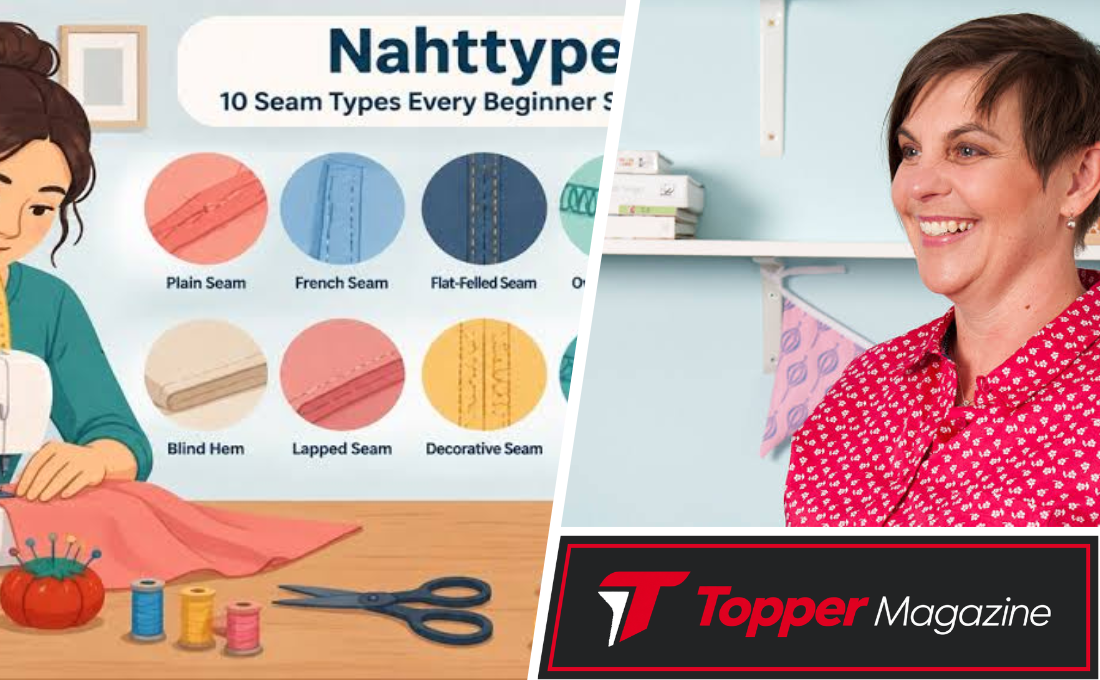
Nahttypen may sound like a complicated technical word, but the basic idea is surprisingly simple. It is a German term commonly used for different types of seams. In sewing and garment construction, a seam is the place where two or more layers of fabric or similar material are joined together with stitches.
Think about your favorite pair of jeans. Look closely at the legs, pockets, waistband, and sides. Those lines of thread are not all doing the same job. Some hold the garment together, some stop fabric from fraying, and others make the clothing look more attractive.
That is where understanding Nahttypen becomes useful.
What Does Nahttypen Mean?
The easiest English meaning of Nahttypen is “types of seams.”
The German word “Naht” refers to a seam or joined line, while “Typen” means types. In textile and clothing discussions, Nahttypen therefore describes the different ways pieces of material can be joined.
The important thing to understand is that a seam and a stitch are not exactly the same.
A stitch is an individual method of passing thread through material. A seam is the complete joined area created when pieces of fabric are connected.
For example, straight stitches can be used to create a basic plain seam. Zigzag or overlock stitches may be used around a seam to control fraying.
Simple, right?
Why Are Nahttypen So Important?
Imagine building a house.
You could have beautiful walls and expensive windows, but the building would still fail if the parts holding everything together were weak. Clothing works in a similar way.
Fabric may get most of the attention because we can see and touch it. However, seams help decide whether a garment stays together during movement, washing, stretching, and everyday use.
The right seam can make a garment:
- stronger and longer lasting
- more comfortable against the skin
- cleaner on the inside
- less likely to fray
- easier to wash
- more flexible
- more professional looking
Seams in clothing are commonly classified by their construction, including plain, lapped, abutted and French seam arrangements.
So choosing Nahttypen is not just about appearance. It is also about performance.
Plain Seam: The Starting Point for Beginners
The plain seam is probably the easiest place to begin.
Two pieces of fabric are normally placed together and sewn along the required seam line. After stitching, the fabric pieces open out while the seam allowances remain on the inside.
It is simple, quick, and useful for many everyday sewing projects.
You may find plain seams in shirts, skirts, dresses, cushions, lightweight jackets, and many other fabric products.
The main weakness is that the raw fabric edges may still fray.
Because of this, sewers often finish those edges using another technique, such as overlocking, zigzag stitching, binding, or another suitable edge finish.
For someone learning Nahttypen for the first time, mastering the plain seam is a sensible starting point.
French Seam: Clean and Beautiful on the Inside
What happens when you want the inside of a garment to look almost as neat as the outside?
This is where a French seam becomes interesting.
A French seam encloses the raw fabric edges inside the seam construction. Instead of leaving loose edges visible on the inside, the fabric is stitched in stages so those edges become hidden.
French seams can work particularly well with lightweight or delicate materials.
They are often appreciated because they create a tidy appearance without requiring a separate overlocked edge.
However, there is a catch.
Because the construction folds material inside itself, it can create unnecessary bulk when used with very thick fabrics.
That means a beautiful seam is not automatically the correct seam for every project.
Flat-Felled Seam: Strong Enough for Hard-Working Clothes
Now look at a pair of jeans.
You may notice strong, flat-looking lines with visible rows of stitching. This type of construction is often associated with the flat-felled seam.
A flat-felled seam encloses raw edges while also creating a strong and relatively flat join.
It is useful where durability matters.
That makes it popular for garments and textile products that experience regular pulling or movement.
Jeans and workwear are familiar examples.
It can also give clothing a recognizable decorative appearance because the stitching may remain visible from the outside.
This is a perfect example of how Nahttypen can affect both strength and style.
Overlocked Seams and Edge Finishing
Have you ever turned a T-shirt inside out?
You may have noticed thread wrapping neatly around the cut fabric edges.
That appearance is often produced using an overlock machine, also called a serger in some regions.
Over-edge stitches are one of the recognized groups used in machine sewing, alongside lockstitches, chain stitches and covering stitches.
Overlocking is popular because it can control fraying while producing an efficient finish.
In clothing factories, speed matters.
Manufacturers may need to produce thousands of garments while keeping seams neat and reliable. Machines designed to trim and secure edges can therefore make production much faster.
For home sewing, an overlocker is useful but not always essential.
A normal sewing machine can often handle beginner projects using alternative edge-finishing techniques.
Flatlock Seams: Useful When Comfort Matters
Sportswear creates another challenge.
Think about leggings, running shirts, gym clothing, or base layers.
These garments stretch and move against the body. A thick seam sitting directly against the skin can become uncomfortable.
Flatlock-style constructions are designed to create flatter joined areas.
This can help reduce bulky ridges.
That is one reason flat-looking seams are common in performance clothing.
When studying Nahttypen, this teaches an important lesson: the best seam does not simply depend on fabric.
You must also think about where the seam will sit on the body and how the finished item will be used.
Lapped Seams
A lapped seam uses overlapping fabric sections rather than joining edges in exactly the same way as a standard plain seam.
This can provide extra strength or create a particular appearance.
The idea is easy to imagine.
Place one piece of material partly over another, then secure the overlapping area.
Different industries may change the exact construction depending on the product and material.
You may see overlapping techniques in heavier fabrics, technical items, leather-like materials, outdoor products, and decorative garment details.
Bound Seams
Raw edges can sometimes be covered with another strip of material.
This creates what is commonly described as a bound finish or bound seam construction.
Why add another piece?
Because covering the edge can make the inside look cleaner while also protecting material that might otherwise fray.
Binding can also become part of the design.
Use contrasting fabric and an ordinary hidden finishing technique suddenly becomes a visible decorative feature.
That is one of the fun things about sewing.
A practical solution can also become a creative choice.
Piped Seams
Have you ever seen a cushion with a raised cord running around its edge?
That detail is usually called piping.
A piped seam places piping or corded material between fabric layers before they are stitched together.
The result creates a raised decorative line.
Piping is common in cushions, upholstery, bags, clothing details, and other textile products.
Its main role may be visual, but depending on the construction, it can also help define an edge.
This shows that Nahttypen are not always selected only for strength.
Sometimes designers simply want a certain look.
Decorative Topstitched Seams
Topstitching is stitching that can deliberately remain visible on the outside.
It may help hold seam allowances in position, strengthen particular areas, or create a decorative line.
Topstitching is commonly seen around pockets, collars, waistbands, jackets, bags and denim.
A designer can even use contrasting thread.
Imagine dark blue denim with golden stitching.
Suddenly, the thread becomes part of the design rather than something that should disappear.
Nahttypen for Stretchy Fabric
Stretch fabric behaves differently from ordinary woven cotton.
Pull a piece of jersey fabric and it moves with you.
If the thread or seam cannot stretch enough, the stitches may break when the garment is pulled over the body.
That means stretchy material often needs stitching and seam construction that can move with the fabric.
Zigzag stitches, overlock stitches and other flexible machine-stitch arrangements can be useful depending on the project. Zigzag and overlock are established machine-stitch types used in sewing.
Before sewing an entire garment, testing the seam on a spare piece of the same material is a smart idea.
Stretch it.
Wash it if needed.
See what happens.
A five-minute test can save an entire project.
Nahttypen for Denim and Heavy Fabric
Heavy materials create the opposite problem.
Instead of being very flexible, they may be thick, stiff and difficult to fold.
Imagine trying to sew through several layers of denim at once.
A seam that works beautifully with thin fabric may become far too bulky.
For tougher garments, strength becomes especially important.
Flat-felled seams and reinforced constructions can be useful options where durability is needed.
But the seam is only one part of the equation.
The needle, thread, machine settings and number of fabric layers also matter.
Trying to force a tiny needle through thick denim is not a clever shortcut.
Nahttypen for Lightweight and Delicate Fabric
Silky, sheer and lightweight materials need a gentler approach.
Bulky seams can show through the outside.
Loose raw edges may also make an otherwise elegant garment look unfinished.
That is why enclosed constructions such as French seams can be attractive for delicate garments.
But accuracy becomes important.
When fabric is very thin, even small sewing mistakes can become visible.
Using an appropriate needle, thread, seam width and machine tension can make a noticeable difference.
Seam Allowance: The Small Space That Matters
When fabric pieces are cut from a pattern, extra material is usually left beyond the actual sewing line.
That extra area is the seam allowance.
It may look like wasted fabric to a beginner.
It is not.
The seam allowance gives you the material needed to create the join.
Different constructions may require different amounts of allowance.
Use too little and you may struggle to complete the seam properly.
Use far too much and the inside may become bulky.
Accurate cutting therefore makes sewing much easier later.
Pressing Can Transform a Seam
Many beginners think pressing comes at the very end.
Experienced sewists know better.
Pressing during construction can help seams sit flatter and look cleaner.
Seam allowances are often pressed during garment construction so they lie in the intended direction and support an even finished result.
This is one of those small habits that can make homemade work look much more polished.
Sew.
Press.
Continue sewing.
It may feel slower, but the final result can be far better.
Common Nahttypen Mistakes Beginners Make
One common mistake is selecting a seam only because it looks attractive.
Appearance matters, but function matters too.
Another mistake is using the same seam for every fabric.
A method that works on cotton may behave very differently on jersey, denim or delicate material.
Beginners also sometimes forget edge finishing.
The outside looks great, but after several washes the inside begins producing loose threads.
Other common problems include poor machine tension, inaccurate seam allowances, unsuitable needles, incorrect thread and skipping pressing.
The useful thing is that most of these mistakes become easier to avoid with practice.
Seam vs Stitch: Do Not Confuse Them
This is one of the biggest areas of confusion around Nahttypen.
A stitch describes how the thread passes through or around the material.
A seam describes how separate pieces of material are joined.
Think of bricks and a wall.
A stitch is like an individual brick or connecting unit.
The seam is more like the complete structure those units help create.
Straight stitch, zigzag, chain stitch and overlock describe stitch forms or stitch families.
Plain seam, French seam and flat-felled seam describe seam constructions.
Once you understand this difference, sewing instructions become much easier to follow.
How to Choose the Right Nahttyp
Before deciding which seam to use, ask yourself a few simple questions.
Is the fabric thick or thin?
Does it stretch?
Does it fray easily?
Will the seam touch the skin?
Will people see the inside of the product?
Does the area experience heavy pulling?
Do I want visible decorative stitching?
Will the item be washed frequently?
Your answers narrow down the options surprisingly quickly.
A lightweight blouse and heavy work trousers clearly do not face the same demands.
Therefore, they should not automatically use identical seam construction.
Are Nahttypen Only Used in Sewing?
This is where the German language can make the keyword slightly confusing.
“Naht” can describe a joining line in more than one technical context. As a result, Nahttypen may occasionally be used when discussing other joining methods rather than clothing alone.
However, when the term appears on fashion, tailoring, dressmaking, textile or sewing websites, it normally refers to seam types.
Context is therefore important.
If you see “Nahttypen” next to fabric, sewing machines and clothing patterns, you know what it means.
Why Learning Nahttypen Makes Sewing Easier
At first, all seams can look similar.
Thread goes through fabric. Two pieces become one.
What could be complicated?
Then you begin noticing the details.
One seam hides its edges.
Another stays flat.
Another stretches.
Another survives heavy wear.
Another becomes part of the decoration.
This is when sewing starts making much more sense.
Instead of asking, “How do I stitch these pieces together?” you begin asking, “Which type of seam would work best here?”
That small change in thinking can greatly improve your projects.
Nahttypen in Modern Clothing Production
Modern clothing factories use specialized sewing machinery to produce seams quickly and consistently.
Home sewers may move slowly around each garment, but industrial production must repeat similar operations thousands of times.
Modern ready-to-wear clothing is commonly produced using mechanized or computerized sewing equipment.
Still, the basic goal has not changed.
Pieces of material must be joined in a way that works for the product.
Machines may become faster and smarter, but understanding seam construction remains important.
Final Thoughts
Nahttypen simply opens the door to understanding the many ways fabric can be joined.
A plain seam can handle everyday construction. A French seam can hide raw edges beautifully. A flat-felled seam can offer a strong and clean finish. Overlocked constructions can control raw edges efficiently, while flatter and stretch-friendly techniques can be useful for active clothing.
The biggest lesson is that there is no single “best” Nahttyp.
The best seam is the one that suits the fabric, the location, the purpose and the finished look you want.
Once you start paying attention to seams, you may never look at clothing the same way again. Turn a shirt or pair of jeans inside out tonight. You will probably discover more engineering in those tiny lines of thread than you expected.
FAQs About Nahttypen
What does Nahttypen mean in English?
Nahttypen is a German term that generally means “types of seams” when used in sewing, textiles, tailoring or garment construction.
What is the easiest Nahttyp for beginners?
A basic plain seam is usually one of the easiest constructions to learn because it is straightforward and widely used.
What is the difference between Nahttypen and stitch types?
Nahttypen refers to seam constructions used to join materials. Stitch types describe the way thread is formed through or around the material.
Which seam is good for lightweight fabric?
French seams are often useful for lightweight fabrics because they enclose raw edges and create a tidy interior.
Which Nahttypen are suitable for jeans?
Strong constructions such as flat-felled seams are commonly associated with denim and workwear because they can provide durability and a clean finish.
Can Nahttypen be used with stretch fabric?
Yes. Stretch materials need seam and stitch combinations that can move with the fabric without breaking easily.
Why do fabric edges need finishing?
Some woven fabrics can unravel or fray at cut edges. Finishing those edges helps keep the inside tidy and can improve durability.
Do I need an overlocker to create good seams?
No. An overlocker is useful, particularly for edge finishing and stretch garments, but many sewing projects can be completed successfully with a standard sewing machine.
Why is pressing important when making seams?
Pressing helps seam allowances settle into position and can produce a flatter, cleaner and more professional-looking finish.
Is Nahttypen only a fashion term?
No. The German word “Naht” can appear in different technical contexts, but in sewing and textile discussions Nahttypen normally means seam types.
For more detailed celebrity-family biographies, hidden life stories, and interesting profiles behind famous names, visit Topper Magazine.
